Small experiment with two thin panels
It was sunny from the morning today, and it turned into a warm day. I worked on the final coating of the 4-sun 18-steps puzzle boxes and continued the production of the Mame puzzle boxes. Since the weather had finally cleared, I thought I could resume work on the Mame 1-sun puzzle boxes, but I felt the humidity was still a bit high in the morning, so I started with the 4-sun boxes first. I was able to complete the 4-sun boxes, and I plan to check the mechanism from tomorrow.
After that, I worked on making the top and bottom panels for the Mame puzzle boxes. The yosegi sheets had already been attached to 2 mm boards, but since it had been raining, I thought the panels might have absorbed moisture, so I waited for clear weather before working on them. These 2 mm panels are used both for the top and bottom panels and for the side panels that will be attached later. They are made from the same size boards with the same yosegi sheets. However, I do not use them randomly. Even though the pattern is the same, I separate them at this stage depending on how they will be used. The selection is based on the wood grain. I first choose the ones for the side panels. All of them are good agathis material, but I carefully select the ones that are softer and have straight grain for the side panels. This is what is called quarter-sawn grain. The parts that feel a bit harder or have more irregular grain are used for the top and bottom panels. Since the top and bottom panels have a larger gluing surface, even if the grain is less uniform, they will hold well and are unlikely to warp later.
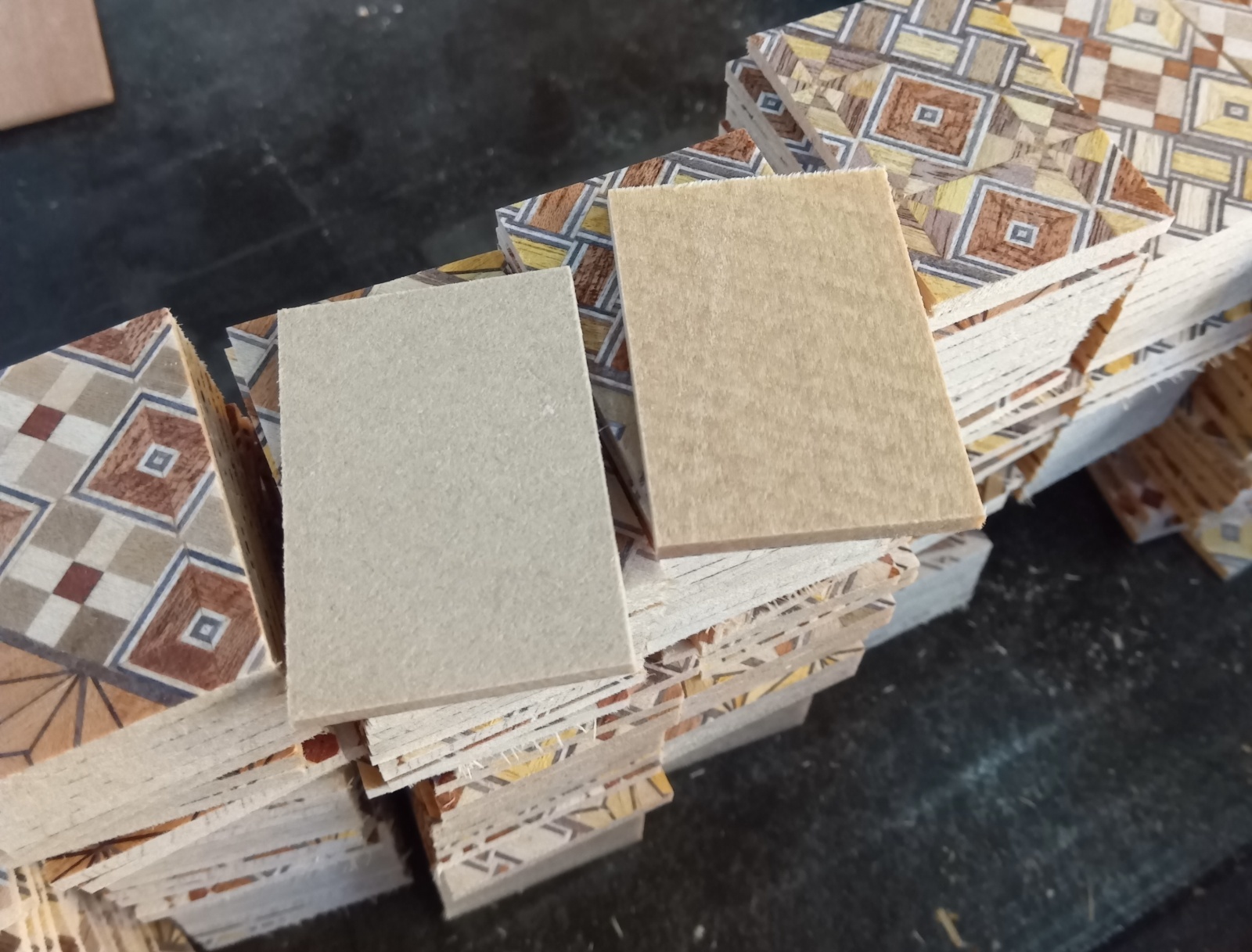
This time, I also included a small experiment. As you can see in the photo, in addition to the usual agathis natural wood panels, I prepared a few panels made by attaching yosegi sheets to MDF boards. I had some leftover yosegi sheets already attached to MDF, so I reduced them to about 2 mm thickness to match the agathis panels. When I made the panels, I noticed that even when cutting them in the same way, the MDF panels turned out slightly larger. The difference is so small that it cannot be measured with a tool, but when I actually fit them into the box, the MDF panels feel tighter. I believe this is because MDF has a very uniform structure, so the saw cuts more straight and accurately. In contrast, natural wood has a more complex grain, so the saw may shift slightly during cutting. So I first cut the MDF panels, then adjusted the machine guide slightly to make the agathis panels just a little wider. The difference is extremely small, probably less than 0.1 mm, but it has a big effect on how the panels move in the box. This time, I used MDF boards with yosegi sheets, originally about 2.5 mm thick, and reduced them to around 2.2 mm. Being able to adjust the thickness like this is another advantage of MDF. With plywood, which is made of layered sheets, it is not possible to shave only the surface for adjustment, as it would disturb the balance of the material.
For this reason, the MDF panels I made this time were used as the bottom panels for the Mame puzzle boxes with Ho wood side panels. In this batch (about 90 pieces), I'm making around 28 boxes with Ho wood side panels.
I hope you have a nice weekend!
After that, I worked on making the top and bottom panels for the Mame puzzle boxes. The yosegi sheets had already been attached to 2 mm boards, but since it had been raining, I thought the panels might have absorbed moisture, so I waited for clear weather before working on them. These 2 mm panels are used both for the top and bottom panels and for the side panels that will be attached later. They are made from the same size boards with the same yosegi sheets. However, I do not use them randomly. Even though the pattern is the same, I separate them at this stage depending on how they will be used. The selection is based on the wood grain. I first choose the ones for the side panels. All of them are good agathis material, but I carefully select the ones that are softer and have straight grain for the side panels. This is what is called quarter-sawn grain. The parts that feel a bit harder or have more irregular grain are used for the top and bottom panels. Since the top and bottom panels have a larger gluing surface, even if the grain is less uniform, they will hold well and are unlikely to warp later.
This time, I also included a small experiment. As you can see in the photo, in addition to the usual agathis natural wood panels, I prepared a few panels made by attaching yosegi sheets to MDF boards. I had some leftover yosegi sheets already attached to MDF, so I reduced them to about 2 mm thickness to match the agathis panels. When I made the panels, I noticed that even when cutting them in the same way, the MDF panels turned out slightly larger. The difference is so small that it cannot be measured with a tool, but when I actually fit them into the box, the MDF panels feel tighter. I believe this is because MDF has a very uniform structure, so the saw cuts more straight and accurately. In contrast, natural wood has a more complex grain, so the saw may shift slightly during cutting. So I first cut the MDF panels, then adjusted the machine guide slightly to make the agathis panels just a little wider. The difference is extremely small, probably less than 0.1 mm, but it has a big effect on how the panels move in the box. This time, I used MDF boards with yosegi sheets, originally about 2.5 mm thick, and reduced them to around 2.2 mm. Being able to adjust the thickness like this is another advantage of MDF. With plywood, which is made of layered sheets, it is not possible to shave only the surface for adjustment, as it would disturb the balance of the material.
For this reason, the MDF panels I made this time were used as the bottom panels for the Mame puzzle boxes with Ho wood side panels. In this batch (about 90 pieces), I'm making around 28 boxes with Ho wood side panels.
I hope you have a nice weekend!