Different sheets and their gluing methods
It rained again today, continuing from yesterday, and the humidity was quite high. So I decided not to attach the top and bottom panels for the Mame puzzle boxes I was working on yesterday, and instead I worked on finishing the 4-sun puzzle boxes from the morning. Yesterday, the humidity was around 60%, and I made the Aruki sliding panels, but I hesitated to make the top and bottom panels. These panels are only about 2 mm thick, so they are easily affected by small changes in the weather. Since it has been raining continuously since yesterday, I thought the panels might already have absorbed moisture, so I decided not to work on them today. These small panels for the Mame puzzle boxes are especially sensitive to changes in the environment. If they are left as they are, they can quickly warp, which shows how easily they lose or gain moisture. If the weather improves tomorrow, I plan to continue the work.
It was raining quite a lot today, so the conditions were not ideal, but I worked on finishing the 4-sun puzzle boxes. A little humidity can actually make finishing work easier than very dry conditions, but if the boxes absorb too much moisture, they can be damaged later when that moisture is released. So I worked quickly and stored them in a humidity-controlled case before moving on to the coating process. This time, I made about 40 pieces of 4-sun 18-steps puzzle boxes. Most of the boxes in this batch have walnut design top and bottom panels, and only five of them have zebrawood panels.
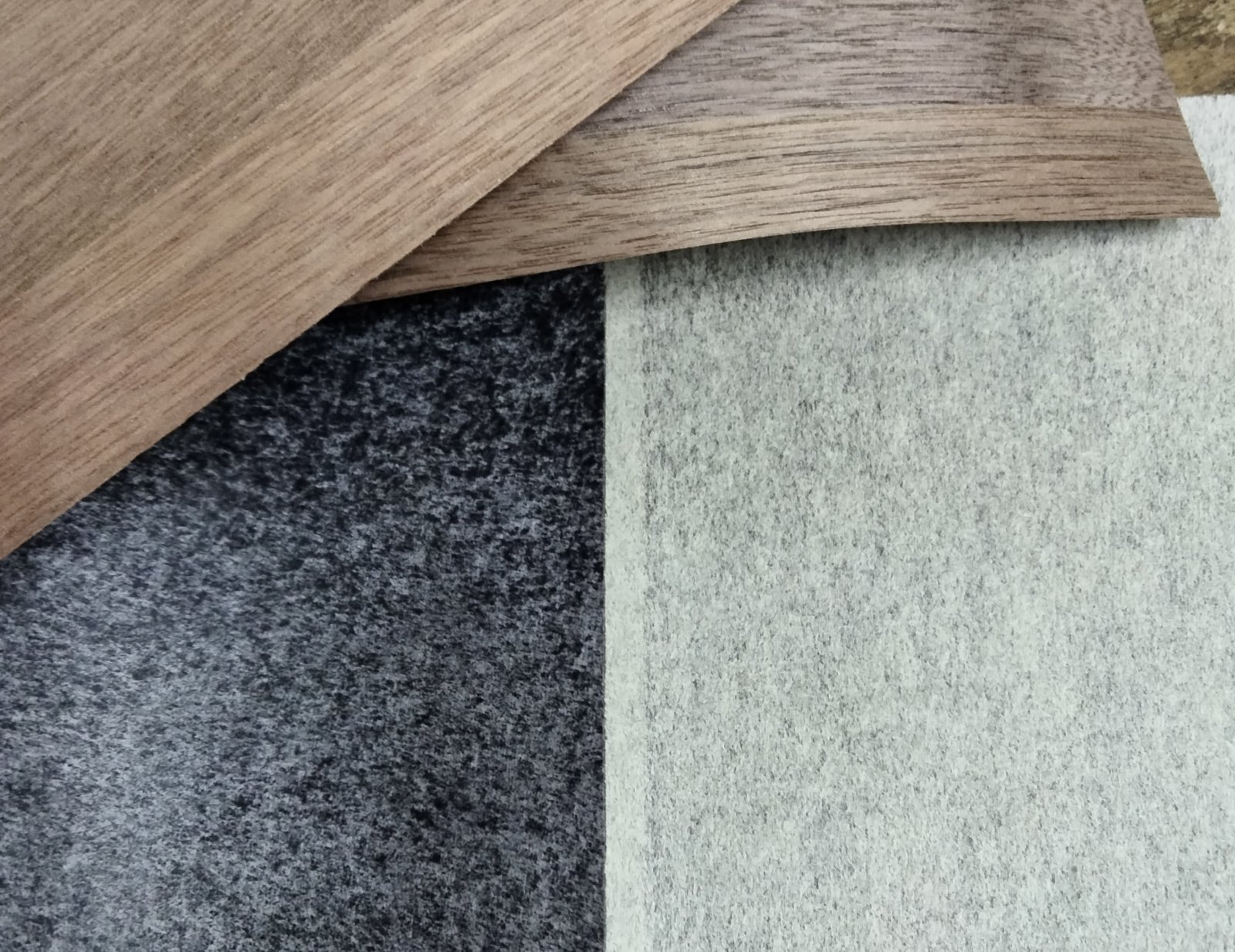
Because of the weather today, there were only limited things I could work on. So I started planning and preparing for the next production. From the requests I have received, I decided to make 4-sun 14-steps puzzle boxes. The ones with traditional yosegi patterns will be delivered to a specific client, so for the rest, I plan to make boxes with random wood grain designs. I expect to make about 40 pieces this time as well. After checking my materials, I found that this batch will use up all of my ichimatsu yosegi sheets for the side panels of the 4-sun boxes, which matches well with making around 40 boxes. Today, I prepared agathis boards and MDF boards to attach the sheets. I was hoping to start the gluing work, but I ran out of time and could only finish preparing the boards. The photo shows the back side of the natural wood sheets that will be attached to the MDF boards. The front side can be seen at the top of the photo. There are two sheets shown side by side. The one on the left is a rosewood sheet that will be used for the back side of the boxes. I will use the right side sheet to make the random yosegi pattern. You can see not only the differences in wood color, but also the differences in the paper attached to the back of the sheets. These thin wood sheets are sold with paper attached so that the pieces do not fall apart.
When I attach these sheets, I use different types of glue depending on the sheet. This is because they do not stick properly if I use the same glue. You might wonder why, since both are made from natural wood and paper. At first, I thought the difference was mainly due to the thickness of the paper. That may be partly true, but I later realized that the type of glue used when the sheet is originally made has a bigger effect. I am not an expert in how these sheets are produced, but if a stronger and more viscous adhesive is used to bond the wood and paper, then later, when I try to attach the sheet, normal wood glue will not stick well to the board. So in this case, for the rosewood sheet, I use a special adhesive and apply heat pressure to attach it. For the sheet on the right, which I use to make the random wood grain pattern, the paper is thinner and the glue used is more watery (lower viscosity), so it can be attached well using my usual wood glue. In fact, if I could not use my usual wood glue, it would be impossible to create the random wood grain designs.
It was raining quite a lot today, so the conditions were not ideal, but I worked on finishing the 4-sun puzzle boxes. A little humidity can actually make finishing work easier than very dry conditions, but if the boxes absorb too much moisture, they can be damaged later when that moisture is released. So I worked quickly and stored them in a humidity-controlled case before moving on to the coating process. This time, I made about 40 pieces of 4-sun 18-steps puzzle boxes. Most of the boxes in this batch have walnut design top and bottom panels, and only five of them have zebrawood panels.
Because of the weather today, there were only limited things I could work on. So I started planning and preparing for the next production. From the requests I have received, I decided to make 4-sun 14-steps puzzle boxes. The ones with traditional yosegi patterns will be delivered to a specific client, so for the rest, I plan to make boxes with random wood grain designs. I expect to make about 40 pieces this time as well. After checking my materials, I found that this batch will use up all of my ichimatsu yosegi sheets for the side panels of the 4-sun boxes, which matches well with making around 40 boxes. Today, I prepared agathis boards and MDF boards to attach the sheets. I was hoping to start the gluing work, but I ran out of time and could only finish preparing the boards. The photo shows the back side of the natural wood sheets that will be attached to the MDF boards. The front side can be seen at the top of the photo. There are two sheets shown side by side. The one on the left is a rosewood sheet that will be used for the back side of the boxes. I will use the right side sheet to make the random yosegi pattern. You can see not only the differences in wood color, but also the differences in the paper attached to the back of the sheets. These thin wood sheets are sold with paper attached so that the pieces do not fall apart.
When I attach these sheets, I use different types of glue depending on the sheet. This is because they do not stick properly if I use the same glue. You might wonder why, since both are made from natural wood and paper. At first, I thought the difference was mainly due to the thickness of the paper. That may be partly true, but I later realized that the type of glue used when the sheet is originally made has a bigger effect. I am not an expert in how these sheets are produced, but if a stronger and more viscous adhesive is used to bond the wood and paper, then later, when I try to attach the sheet, normal wood glue will not stick well to the board. So in this case, for the rosewood sheet, I use a special adhesive and apply heat pressure to attach it. For the sheet on the right, which I use to make the random wood grain pattern, the paper is thinner and the glue used is more watery (lower viscosity), so it can be attached well using my usual wood glue. In fact, if I could not use my usual wood glue, it would be impossible to create the random wood grain designs.