Adjusting the grooves and aruki panels
A new week has started again today. As usual, I began working from the morning. However, it was raining early in the day, so the humidity was a bit high. Because of that, I thought for a moment about whether I should go ahead with making the Aruki panels for the 4-sun 18-steps puzzle box as planned. Since the rain had just started in the early morning, the humidity was not too high yet, so I decided to at least go ahead and make them. I started the work and was able to complete it within the morning. I wanted to continue with the assembly, but I decided not to do that yet, and instead began working on the Mame (tiny 1-sun size) puzzle boxes with a 14-step mechanism.
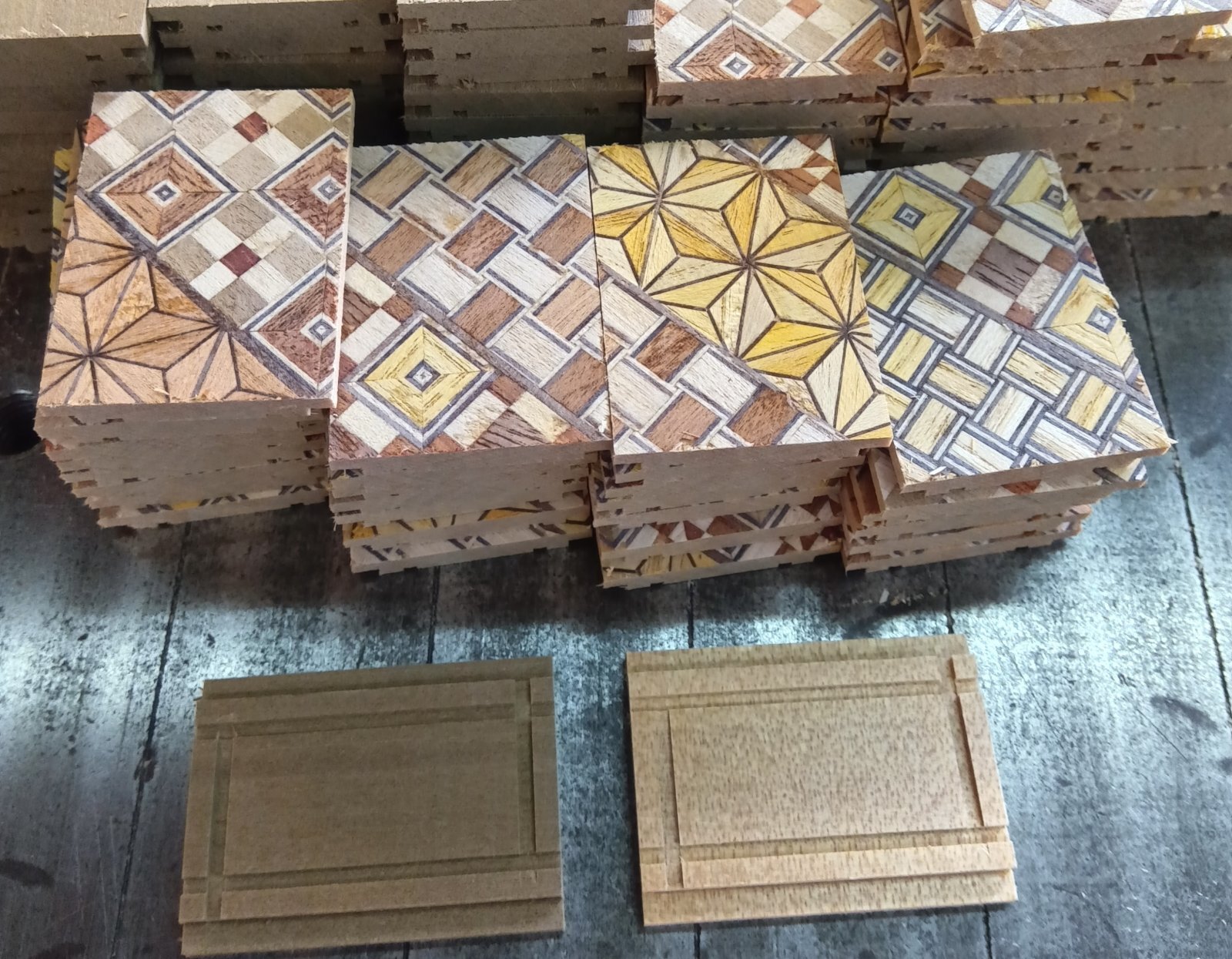
As some of you may know from my previous post, for this batch of Mame puzzle boxes, in addition to the traditional yosegi type, I will also be making a version with Ho wood side panels. Today, I first prepared the materials and worked on making the core panels and the long side panels. In other words, this is the frame that forms the main structure of the box. The photo shows these long side panels, and I am currently cutting four grooves into them. This time, there are two types shown in the photo: one with the usual traditional yosegi applied to the side panels, and the other made from solid Ho wood. Each panel has four grooves cut into it, but Mame puzzle boxes are different from standard Japanese puzzle boxes. Instead of having an internal mechanism, the box opens using only the movement of the four panels themselves. In a typical Japanese puzzle box, the side Aruki sliding panels move in connection with the internal mechanism. As the internal mechanism moves step by step, the Aruki panels also move along with it. Once the mechanism reaches its limit, the Aruki panels can no longer move any further, because everything is linked together.
However, with this kind of mechanism that uses only the panels, there is no internal structure to stop the side panels. Because of that, the panels could keep sliding endlessly and would finally come out of the frame. That would be a problem, so to prevent this, I use a method in which the grooves for the sliding panels are not cut all the way to the end. It is a bit like train tracks. If there are no tracks, the train cannot go any farther. If you look closely at the photo, you can see that two of the shorter grooves are only cut part of the way. The position where these grooves stop is very important. The grooves must be cut at exactly the right point so that the panels stop correctly. The movement of this mechanism is very small, only about 1.3 mm (one step), so even a slight difference can prevent it from working properly. Also, the stopping position of the panels is not determined by the grooves alone. It is also affected by the width of the Aruki panels and the length of the panel legs. All of these need to match, otherwise the panels will not stop in the correct place. So how do I adjust this position each time? The answer is intuition. There is no fixed measurement. After many years of making these boxes, I work based on a sense of what feels right. I do not use detailed drawings, but this intuition becomes more reliable the more I make them. I have also learned how to make small adjustments if something is slightly off. At the same time, if I stop making them, I can forget that sense. That is why it is very important to keep making them.
After that, the weather cleared and the humidity went down, so I attached the Aruki panels to the 4-sun 18-steps puzzle box and placed it in a humidity-controlled case 🌤️
As some of you may know from my previous post, for this batch of Mame puzzle boxes, in addition to the traditional yosegi type, I will also be making a version with Ho wood side panels. Today, I first prepared the materials and worked on making the core panels and the long side panels. In other words, this is the frame that forms the main structure of the box. The photo shows these long side panels, and I am currently cutting four grooves into them. This time, there are two types shown in the photo: one with the usual traditional yosegi applied to the side panels, and the other made from solid Ho wood. Each panel has four grooves cut into it, but Mame puzzle boxes are different from standard Japanese puzzle boxes. Instead of having an internal mechanism, the box opens using only the movement of the four panels themselves. In a typical Japanese puzzle box, the side Aruki sliding panels move in connection with the internal mechanism. As the internal mechanism moves step by step, the Aruki panels also move along with it. Once the mechanism reaches its limit, the Aruki panels can no longer move any further, because everything is linked together.
However, with this kind of mechanism that uses only the panels, there is no internal structure to stop the side panels. Because of that, the panels could keep sliding endlessly and would finally come out of the frame. That would be a problem, so to prevent this, I use a method in which the grooves for the sliding panels are not cut all the way to the end. It is a bit like train tracks. If there are no tracks, the train cannot go any farther. If you look closely at the photo, you can see that two of the shorter grooves are only cut part of the way. The position where these grooves stop is very important. The grooves must be cut at exactly the right point so that the panels stop correctly. The movement of this mechanism is very small, only about 1.3 mm (one step), so even a slight difference can prevent it from working properly. Also, the stopping position of the panels is not determined by the grooves alone. It is also affected by the width of the Aruki panels and the length of the panel legs. All of these need to match, otherwise the panels will not stop in the correct place. So how do I adjust this position each time? The answer is intuition. There is no fixed measurement. After many years of making these boxes, I work based on a sense of what feels right. I do not use detailed drawings, but this intuition becomes more reliable the more I make them. I have also learned how to make small adjustments if something is slightly off. At the same time, if I stop making them, I can forget that sense. That is why it is very important to keep making them.
After that, the weather cleared and the humidity went down, so I attached the Aruki panels to the 4-sun 18-steps puzzle box and placed it in a humidity-controlled case 🌤️