Advantages of ho wood mame box
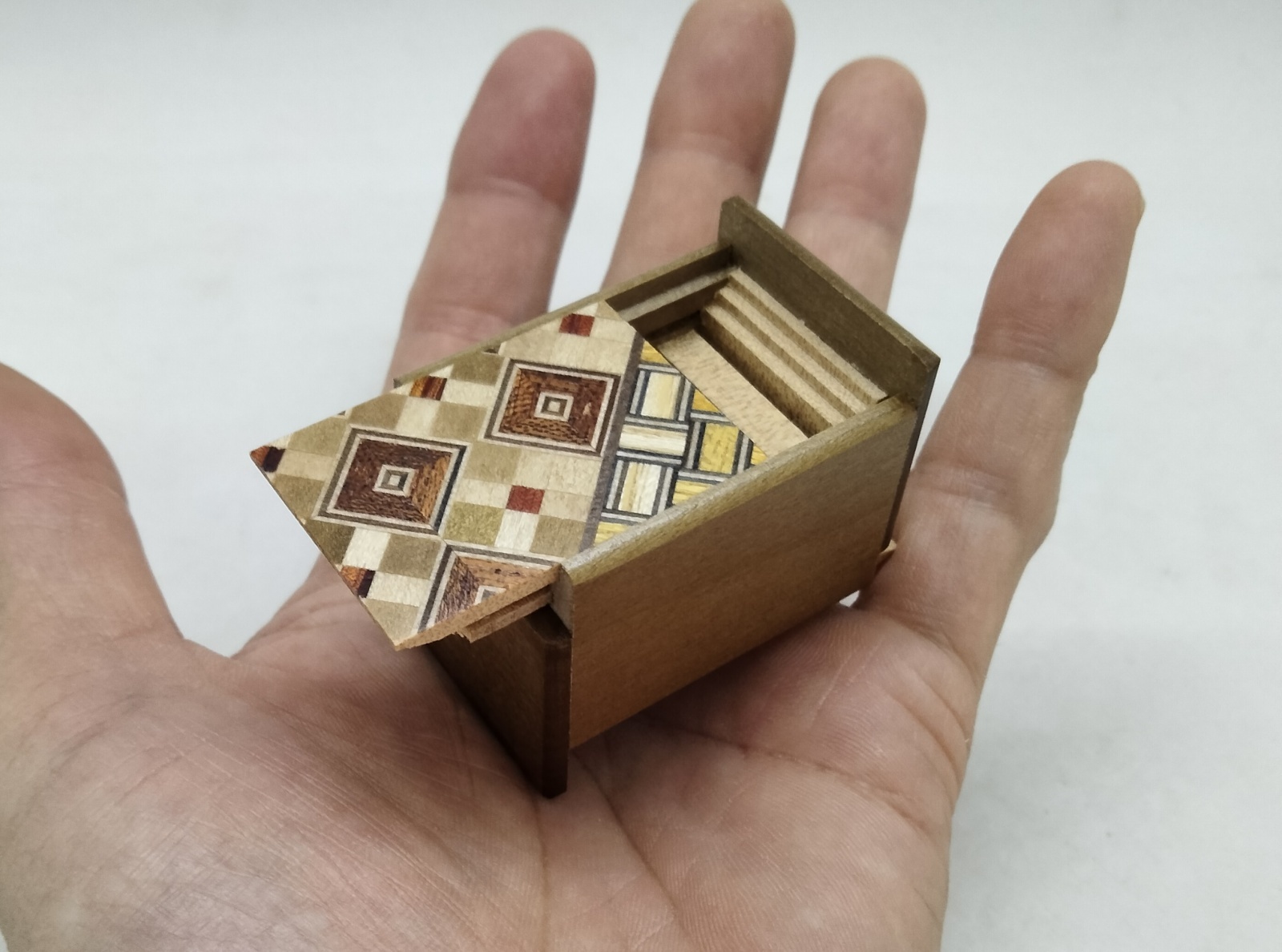
I had some errands to take care of today, so I went out. It was the Spring Equinox holiday, and the weather here was originally expected to be cloudy, but it ended up raining on and off throughout the day. I went toward the city, so the roads were not too crowded, but the opposite direction, toward the tourist areas, was very busy. Since today marks the start of a three-day weekend, and for many people the beginning of spring break, I think that is why there were so many people traveling. Even though I was out, I stopped by my workshop in the morning and again in the evening to do a little work. Today I mainly worked on the final finishing coat for a 5-sun 27-steps puzzle box. It was the usual process, and although it got late, I was able to finish it safely. This time, I also made a new design type, so I plan to introduce it on this site soon. First, I will do a final check and then place it in a gift box.
The 5-sun 27-steps puzzle box is now finished, and I am currently working on a 4-sun 18-steps puzzle box. I have not started assembling it yet, but I have already been thinking about my next project. Next, I plan to make Mame puzzle boxes with a 14-step mechanism. About two weeks ago, I prepared for this by attaching yosegi sheets to wooden boards, since I had some orders to work on. By now, they should be well dried. These were prepared mainly for requests from two different places, so I only had materials for those orders. However, today I decided to make a few more and also add a design that combines yosegi and Ho wood, which I made last year (photo). These will be kept as my own stock. Ho wood is relatively soft and easy to work with. It is used not only for the outer design, but also for the internal structure of puzzle boxes. However, because it is soft, it can be easily scratched, so careful handling is important during production. Mame puzzle boxes are very small, and it is difficult to polish them with machines, so using a soft wood like Ho wood is helpful when polishing by hand. If the wood is hard, it becomes much more difficult to work by hand. Another advantage of its softness is that, as shown in the photo, the corners can be rounded. This is possible with other woods as well, but unless the wood has a fine and even texture like Ho wood, it can easily chip or crack. The panels are very thin, about 2 mm, so if too much force is applied when using woodworking machines, harder woods can break easily. In this respect, Ho wood can be worked in a similar way to agathis wood. I have not decided on the exact number yet, but Since I have nearly 60 pieces for the traditional yosegi type, I probably won’t be able to add many Ho wood versions.
Also, a slightly rare box arrived today. It is a low-priced box, but it is quite old. If I have a chance, I would like to share it on Instagram or somewhere similar.This is a 2-step coin bank–type Japanese puzzle box that is still being sold today. It seems to be well made, as it still works perfectly. However, perhaps because it is inexpensive, it appears that a wood other than katsura is used.
Have a great weekend!
The 5-sun 27-steps puzzle box is now finished, and I am currently working on a 4-sun 18-steps puzzle box. I have not started assembling it yet, but I have already been thinking about my next project. Next, I plan to make Mame puzzle boxes with a 14-step mechanism. About two weeks ago, I prepared for this by attaching yosegi sheets to wooden boards, since I had some orders to work on. By now, they should be well dried. These were prepared mainly for requests from two different places, so I only had materials for those orders. However, today I decided to make a few more and also add a design that combines yosegi and Ho wood, which I made last year (photo). These will be kept as my own stock. Ho wood is relatively soft and easy to work with. It is used not only for the outer design, but also for the internal structure of puzzle boxes. However, because it is soft, it can be easily scratched, so careful handling is important during production. Mame puzzle boxes are very small, and it is difficult to polish them with machines, so using a soft wood like Ho wood is helpful when polishing by hand. If the wood is hard, it becomes much more difficult to work by hand. Another advantage of its softness is that, as shown in the photo, the corners can be rounded. This is possible with other woods as well, but unless the wood has a fine and even texture like Ho wood, it can easily chip or crack. The panels are very thin, about 2 mm, so if too much force is applied when using woodworking machines, harder woods can break easily. In this respect, Ho wood can be worked in a similar way to agathis wood. I have not decided on the exact number yet, but Since I have nearly 60 pieces for the traditional yosegi type, I probably won’t be able to add many Ho wood versions.
Also, a slightly rare box arrived today. It is a low-priced box, but it is quite old. If I have a chance, I would like to share it on Instagram or somewhere similar.This is a 2-step coin bank–type Japanese puzzle box that is still being sold today. It seems to be well made, as it still works perfectly. However, perhaps because it is inexpensive, it appears that a wood other than katsura is used.
Have a great weekend!