Choosing the right wood for small parts
Today was a cold day, quite different from yesterday’s warm spring-like weather. The sky was cloudy and there was no sunshine. I worked on several tasks today as well.I
t was cold in the morning, so while warming myself by the heater 😅 I checked the mechanisms of the finished 3-sun 12-steps puzzle boxes. These boxes had just finished the coating process, so of course the mechanisms were completely stuck together by the paint. I carefully separate the parts while opening them, but if you force them open, the wood where the parts are stuck can be pulled by the paint and crack or split. This requires quite a bit of experience. I learned how to open these stuck boxes after breaking many of them along the way (haha… but it’s true). Today I was able to open all the boxes without breaking them. One of them had a small internal part that I had forgotten to install, but I fixed that as well. Once the internal mechanism is completed, you normally cannot reach inside from the outside, but of course it can still be repaired. I learned how to do this in my own way.
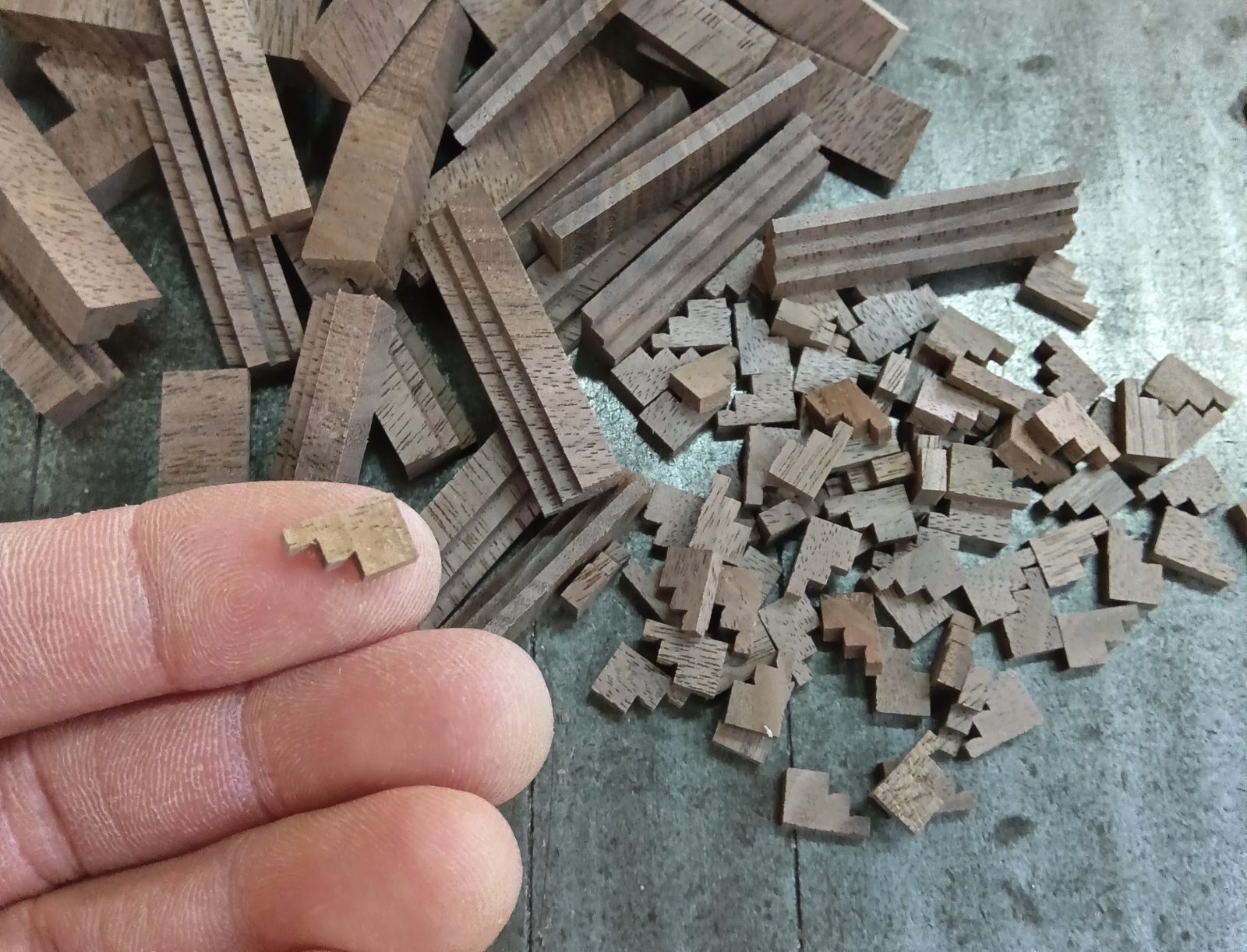
After that, I worked on the 5-sun 27-steps puzzle boxes that have just started production. Today I made some additional internal parts that were missing for this batch, and I also made the “hashibami” structure for the top and bottom Aruki panels. Hashibami is a method used to prevent the panels from warping. Three pieces of wood are joined together so that their wood grain crosses each other. I use this method for boxes of 5-sun size or larger, where the top Aruki panel becomes relatively large. The photo shows the internal parts currently being made. For this batch, these parts and another type were not enough, so I produced more. I always make a few extra pieces, not only for this production but also so they can be used for future work. The part shown in the photo is attached to the upper right corner of the internal mechanism (assuming the Aruki panel moves downward). In the 27-step mechanism, two of these parts are installed in each box. Although this part is small, it requires some delicate shaping. For that reason, I prefer to use a slightly harder wood, and I use walnut for it every time. However, it is not the high-quality straight-grain walnut that I use for the outside of the box. Instead, I save some of the more difficult pieces of walnut and use them for this purpose. It is not simply a matter of using the hardest wood possible. If the wood is too hard, the thin protruding parts—like the ones you see here—can easily chip. Walnut has a good balance of hardness while still keeping a bit of flexibility, which makes it just right for this part.
By the way, I also did something a little interesting this morning. I filmed a new video and uploaded it to YouTube. This time it shows how to open a Mame 14-step puzzle box and explains its mechanism. I’m not speaking in the video 😅, but there are text explanations. I would like to upload more videos like this in the future, showing how the boxes work and some parts of the making process. They might be a bit too technical and not very entertaining~🤣, but I hope some people will enjoy them.
https://www.youtube.com/watch?v=PMfZyUGJEm8
Have a nice weekend!
t was cold in the morning, so while warming myself by the heater 😅 I checked the mechanisms of the finished 3-sun 12-steps puzzle boxes. These boxes had just finished the coating process, so of course the mechanisms were completely stuck together by the paint. I carefully separate the parts while opening them, but if you force them open, the wood where the parts are stuck can be pulled by the paint and crack or split. This requires quite a bit of experience. I learned how to open these stuck boxes after breaking many of them along the way (haha… but it’s true). Today I was able to open all the boxes without breaking them. One of them had a small internal part that I had forgotten to install, but I fixed that as well. Once the internal mechanism is completed, you normally cannot reach inside from the outside, but of course it can still be repaired. I learned how to do this in my own way.
After that, I worked on the 5-sun 27-steps puzzle boxes that have just started production. Today I made some additional internal parts that were missing for this batch, and I also made the “hashibami” structure for the top and bottom Aruki panels. Hashibami is a method used to prevent the panels from warping. Three pieces of wood are joined together so that their wood grain crosses each other. I use this method for boxes of 5-sun size or larger, where the top Aruki panel becomes relatively large. The photo shows the internal parts currently being made. For this batch, these parts and another type were not enough, so I produced more. I always make a few extra pieces, not only for this production but also so they can be used for future work. The part shown in the photo is attached to the upper right corner of the internal mechanism (assuming the Aruki panel moves downward). In the 27-step mechanism, two of these parts are installed in each box. Although this part is small, it requires some delicate shaping. For that reason, I prefer to use a slightly harder wood, and I use walnut for it every time. However, it is not the high-quality straight-grain walnut that I use for the outside of the box. Instead, I save some of the more difficult pieces of walnut and use them for this purpose. It is not simply a matter of using the hardest wood possible. If the wood is too hard, the thin protruding parts—like the ones you see here—can easily chip. Walnut has a good balance of hardness while still keeping a bit of flexibility, which makes it just right for this part.
By the way, I also did something a little interesting this morning. I filmed a new video and uploaded it to YouTube. This time it shows how to open a Mame 14-step puzzle box and explains its mechanism. I’m not speaking in the video 😅, but there are text explanations. I would like to upload more videos like this in the future, showing how the boxes work and some parts of the making process. They might be a bit too technical and not very entertaining~🤣, but I hope some people will enjoy them.
https://www.youtube.com/watch?v=PMfZyUGJEm8
Have a nice weekend!