Comparing two engineered materials
Over the past few days it has become quite warm, and the mornings have been a little easier. A new week has started, and I continued working in the workshop today. Most of today’s work was focused on the 5-sun 27-steps puzzle boxes. Today’s work has just finished, and I have already attached the top and bottom panels of the 5-sun boxes. During the day I continued making the Aruki sliding panels and installed them, then made the top and bottom panels and attached them as well.This time as well, I used katsura wood for the side Aruki panels because I had pieces in just the right size. It has good flexibility and was easy to work with. The top and bottom panels are made from agathis wood as usual.
This time, about half of the boxes are the traditional yosegi model, and the other half are a new design that combines traditional yosegi and ichimatsu yosegi. For the boxes that use ichimatsu yosegi, I used MDF board as the base material for the top and bottom yosegi panels. Of course, I understand that people have different opinions about MDF board, but since this part cannot be seen from the outside, I think it is a useful choice from the standpoint of panel stability. The biggest drawback of MDF board is that it is extremely weak against water, and therefore it may also be somewhat sensitive to humidity. That is a small concern, but I still use it because of its stability. For the other design, the panels use shina plywood, which has been my standard material for a long time. As I wrote the other day, shina wood makes the colors of the yosegi sheets appear more vivid. Ideally, I would prefer to use shina plywood whenever possible. However, something I noticed today is that compared with MDF board, it is a little more difficult to work with. Perhaps this is due to the quality of recent plywood, but the laminated layers tend to separate more easily, and the edges also splinter more easily. This may be related to the quality of the shina wood itself.
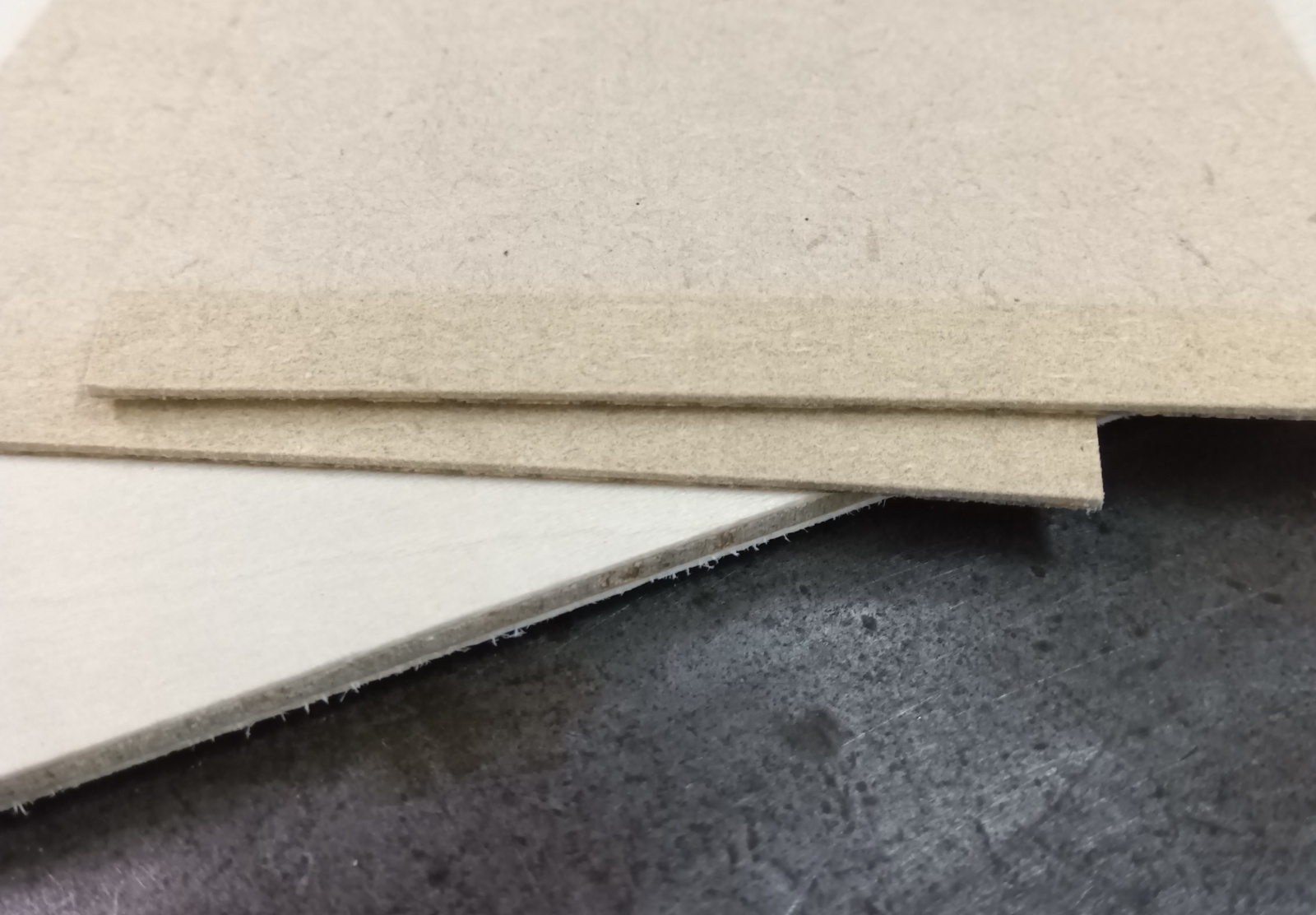
While I was cutting the panels today, I had a small problem. Two pieces (shina plywood) did not cut quite right and ended up slightly narrower than they should have been. At the same time, I was also cutting the MDF panels, so the difference between the two materials became even more noticeable. Even when cut to the same measurement, the shina plywood ends up just a little narrower. Because of that, I adjusted the ruler slightly for the shina plywood, shifting it about 0.1 to 0.2 mm to make the width a little larger before cutting. MDF board has no grain direction or natural irregularities, so it can be cut more consistently. For a long time, I have used shina plywood for the top and bottom yosegi panels of the traditional yosegi models. However, today’s experience made me think that perhaps I should consider switching these panels to MDF in the future as well (The photo shows an MDF panel placed on top of shina plywood).
This time, about half of the boxes are the traditional yosegi model, and the other half are a new design that combines traditional yosegi and ichimatsu yosegi. For the boxes that use ichimatsu yosegi, I used MDF board as the base material for the top and bottom yosegi panels. Of course, I understand that people have different opinions about MDF board, but since this part cannot be seen from the outside, I think it is a useful choice from the standpoint of panel stability. The biggest drawback of MDF board is that it is extremely weak against water, and therefore it may also be somewhat sensitive to humidity. That is a small concern, but I still use it because of its stability. For the other design, the panels use shina plywood, which has been my standard material for a long time. As I wrote the other day, shina wood makes the colors of the yosegi sheets appear more vivid. Ideally, I would prefer to use shina plywood whenever possible. However, something I noticed today is that compared with MDF board, it is a little more difficult to work with. Perhaps this is due to the quality of recent plywood, but the laminated layers tend to separate more easily, and the edges also splinter more easily. This may be related to the quality of the shina wood itself.
While I was cutting the panels today, I had a small problem. Two pieces (shina plywood) did not cut quite right and ended up slightly narrower than they should have been. At the same time, I was also cutting the MDF panels, so the difference between the two materials became even more noticeable. Even when cut to the same measurement, the shina plywood ends up just a little narrower. Because of that, I adjusted the ruler slightly for the shina plywood, shifting it about 0.1 to 0.2 mm to make the width a little larger before cutting. MDF board has no grain direction or natural irregularities, so it can be cut more consistently. For a long time, I have used shina plywood for the top and bottom yosegi panels of the traditional yosegi models. However, today’s experience made me think that perhaps I should consider switching these panels to MDF in the future as well (The photo shows an MDF panel placed on top of shina plywood).