Applying natural wood veneer
It was sunny again from the morning today, but it turned out to be a chilly day. I spent the whole day working in the workshop. For now, I have paused the structural work on the 4-sun 27-steps puzzle boxes and have been preparing the panels instead. At the same time, I have also started preparing the 4-sun 14-steps puzzle boxes. As I wrote yesterday, I still have some materials left from a previous production, so this time I am making the boxes to match those materials. Specifically, I have Aruki sliding panels and side panels for the structural part already prepared. The Aruki panels are completely finished, and I will build everything else to match them. Usually, I complete the structural frame first and then make the Aruki panels to fit it, so this is the reverse order and a little more difficult 😅 However, this is not the first time I have done it this way. In the past, when preparing materials, I once miscalculated the quantity and made far too many parts—sometimes even double the needed amount. As a result, I had enough Aruki panels left to make another full batch of puzzle boxes. It would have been a waste to throw them away, so I made another lot to match those panels. This time, I will make about 20 boxes, so the number is not so large.
This time, for the 14-steps puzzle boxes, I decided to add a few boxes in a random wood grain design in addition to the usual yosegi type. Because the number of yosegi panels is limited, I will make as many boxes as possible with yosegi panels, and the remaining ones will be made in the random wood grain style. For the 4-sun 27-steps puzzle boxes, however, I decided not to use the random wood grain design. Instead, I will use traditional yosegi and natural woods such as zebrawood for those boxes.
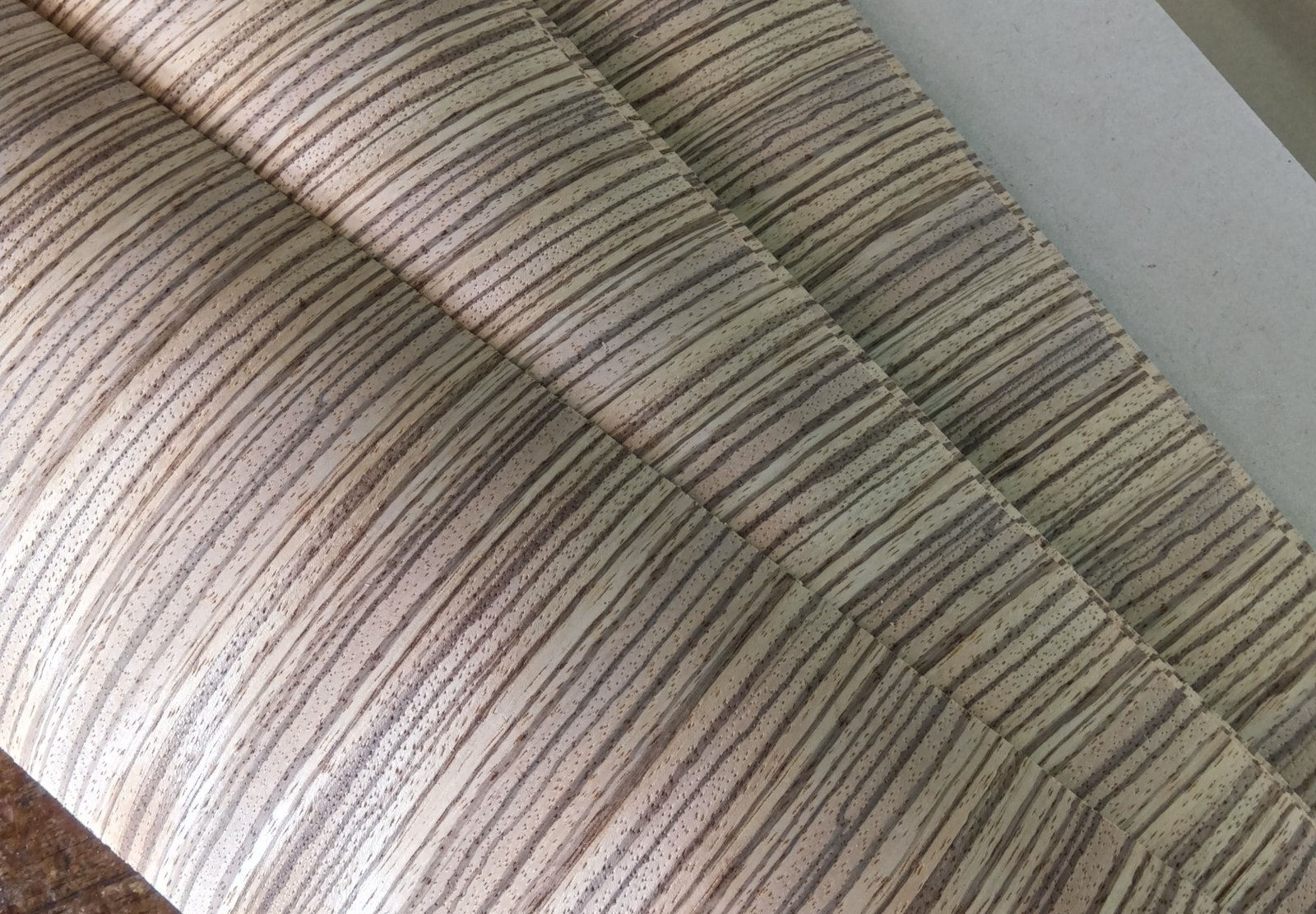
With that plan in mind, today I glued various sheets onto boards according to the number needed for each type of box. I also attached the ichimatsu yosegi sheets for the side panels of the 14-steps puzzle boxes. The photo shows the zebrawood veneer sheets for the 27-steps puzzle boxes. This time, I also plan to make some walnut designs, but those sheets were already attached earlier, so today I only glued the zebrawood veneer. I usually attach this natural wood veneer last, after finishing the other yosegi sheets. This is because the veneer requires a slightly special type of glue. Once I use that glue, I have to wash the tools before I can use them again. It is fine if regular glue mixes into the special glue, but not the other way around. Originally, this veneer comes in long sheets, about two meters in length. However, as shown in the photo, I cut them before gluing. If I leave them too long, they will not fit into the woodworking clamps used for pressing after gluing. I do not cut them randomly; the length is made about one or two centimeters longer than the vertical length of the 4-sun box. After gluing, I gradually cut the board to the proper size, and that becomes the exact length of the top and bottom panels.
This time, for the 14-steps puzzle boxes, I decided to add a few boxes in a random wood grain design in addition to the usual yosegi type. Because the number of yosegi panels is limited, I will make as many boxes as possible with yosegi panels, and the remaining ones will be made in the random wood grain style. For the 4-sun 27-steps puzzle boxes, however, I decided not to use the random wood grain design. Instead, I will use traditional yosegi and natural woods such as zebrawood for those boxes.
With that plan in mind, today I glued various sheets onto boards according to the number needed for each type of box. I also attached the ichimatsu yosegi sheets for the side panels of the 14-steps puzzle boxes. The photo shows the zebrawood veneer sheets for the 27-steps puzzle boxes. This time, I also plan to make some walnut designs, but those sheets were already attached earlier, so today I only glued the zebrawood veneer. I usually attach this natural wood veneer last, after finishing the other yosegi sheets. This is because the veneer requires a slightly special type of glue. Once I use that glue, I have to wash the tools before I can use them again. It is fine if regular glue mixes into the special glue, but not the other way around. Originally, this veneer comes in long sheets, about two meters in length. However, as shown in the photo, I cut them before gluing. If I leave them too long, they will not fit into the woodworking clamps used for pressing after gluing. I do not cut them randomly; the length is made about one or two centimeters longer than the vertical length of the 4-sun box. After gluing, I gradually cut the board to the proper size, and that becomes the exact length of the top and bottom panels.