Katsura wood aruki panels
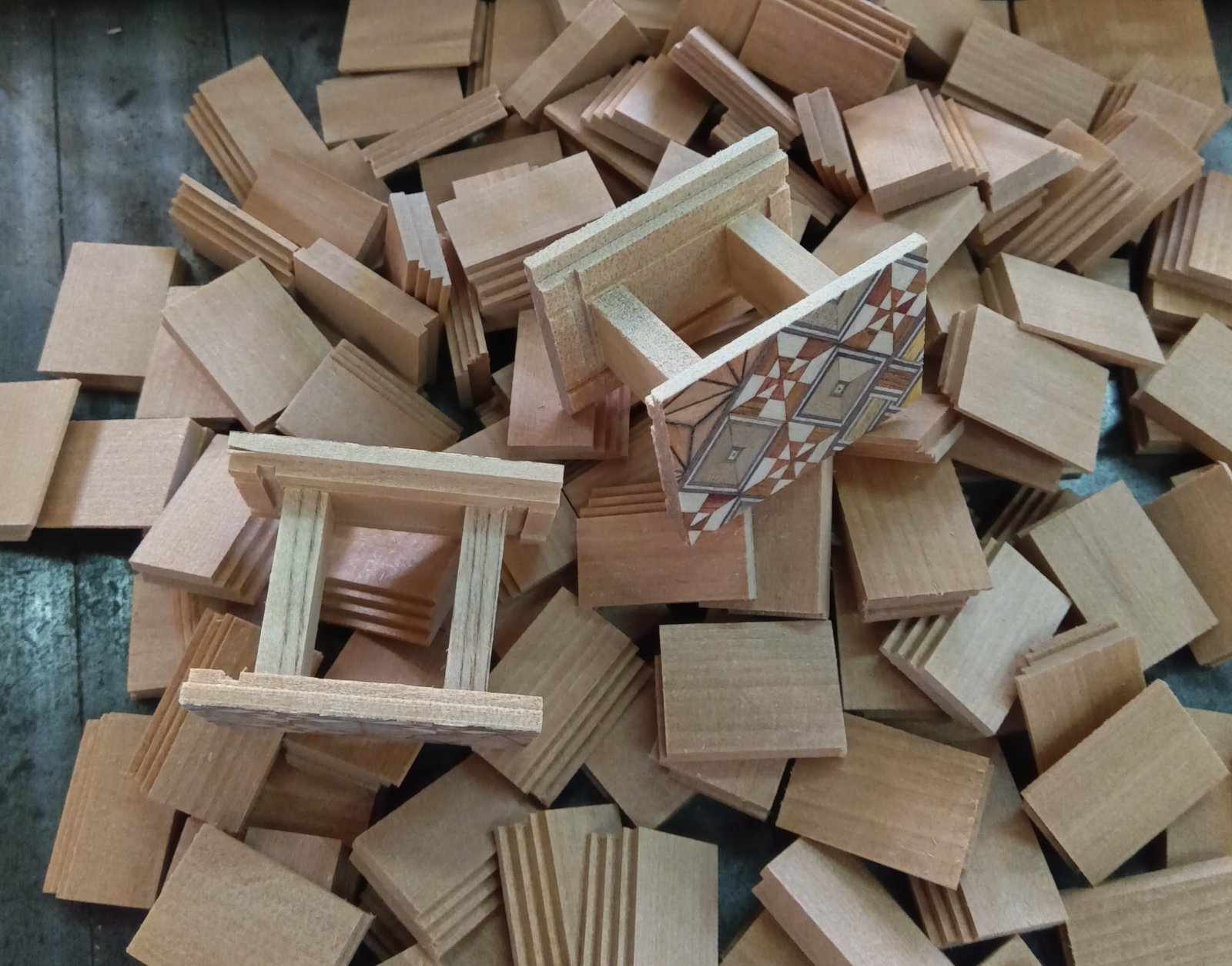
This morning was very cold due to the strong cold air, with temperatures around minus three degrees Celsius. It snowed last night, so I was worried that the roads might be icy, but I managed to get to the workshop safely. This cold weather is expected to continue until around Sunday. In the northern parts of Japan, it seems that some areas are experiencing heavy snowfall. When it gets this cold, my hands become stiff, and fine work can be quite difficult. But right now, I am in the middle of making Mame 18-steps puzzle boxes, which require especially delicate work 😅. Since yesterday, I have been assembling the frame panels, and using those completed frames, I worked on making the Aruki panels for these Mame puzzle boxes today, dividing the work between the morning and the afternoon.
I usually divide the work on the Aruki panels for the Mame 18-step puzzle boxes over two days, or at least between the morning and the afternoon. This is because the step-like carving on these panels takes a bit more time. Compared to the 10-step or 14-step mechanisms, the number of steps is much higher. Today, I started around ten in the morning, after it had warmed up a little. During the morning, I worked mainly on carving the step-shaped structure and stopped there. In the afternoon, I continued the work and was able to finish everything safely.
Some of you may notice from the photo, but for the Aruki panels this time, I am using katsura wood from Japan. I happened to find some very nice katsura, so I decided to use it specifically for the Aruki panels this time. It has been quite a while since I last used katsura, and it has its own distinctive, pleasant scent. It is also very elastic and feels excellent to work with. Once again, it reminded me that katsura wood is very well suited for Aruki panels. That said, katsura can chip a little more easily, so extra care is needed. In the past, Japanese puzzle boxes were traditionally made using katsura wood. When I first started making boxes in my own workshop, I was still able to obtain good-quality katsura. Over time, however, it became harder to find, and I eventually switched completely to agathis wood. Those who own older puzzle boxes may notice this difference. The overall feeling of the box is quite different. Boxes made with katsura feel lighter and more rustic. Because Mame puzzle boxes require especially delicate Aruki panel work, I would ideally like to use katsura for these panels whenever possible. This time, I was lucky to obtain some at just the right moment, so I am very glad.
I usually divide the work on the Aruki panels for the Mame 18-step puzzle boxes over two days, or at least between the morning and the afternoon. This is because the step-like carving on these panels takes a bit more time. Compared to the 10-step or 14-step mechanisms, the number of steps is much higher. Today, I started around ten in the morning, after it had warmed up a little. During the morning, I worked mainly on carving the step-shaped structure and stopped there. In the afternoon, I continued the work and was able to finish everything safely.
Some of you may notice from the photo, but for the Aruki panels this time, I am using katsura wood from Japan. I happened to find some very nice katsura, so I decided to use it specifically for the Aruki panels this time. It has been quite a while since I last used katsura, and it has its own distinctive, pleasant scent. It is also very elastic and feels excellent to work with. Once again, it reminded me that katsura wood is very well suited for Aruki panels. That said, katsura can chip a little more easily, so extra care is needed. In the past, Japanese puzzle boxes were traditionally made using katsura wood. When I first started making boxes in my own workshop, I was still able to obtain good-quality katsura. Over time, however, it became harder to find, and I eventually switched completely to agathis wood. Those who own older puzzle boxes may notice this difference. The overall feeling of the box is quite different. Boxes made with katsura feel lighter and more rustic. Because Mame puzzle boxes require especially delicate Aruki panel work, I would ideally like to use katsura for these panels whenever possible. This time, I was lucky to obtain some at just the right moment, so I am very glad.