Types of glue for sheet bonding
Today was another bright and sunny day. It was cold in the morning, but by early afternoon the sunshine felt warm. Today, I worked on the finishing process for the 4-sun puzzle boxes. If there are any areas that need small repairs, this is the stage when I take care of them. The ichimatsu yosegi used on the side panels has wood grain running vertically along the box. Because of this, the surface can peel more easily when the corners of the box are rounded. I am always careful about this point, and from the very first steps I take various measures to prevent problems. One of the most important points is not to use too little glue when attaching the ichimatsu yosegi sheets to the board, and to use glue that is slightly softer.
The glue used for yosegi and for making the boxes is water-based, and manufacturers sell many different types with different amounts of water in them. Among these, it is important to use a glue that has enough moisture and is not too hard when attaching yosegi sheets to a board. By doing this, the glue can soak slightly into the yosegi sheet and bond it more firmly to the board. If a harder glue is used and it only sticks on the surface, the sheet can come off when strong force is applied, for example during cutting or other work with tools. I followed the same approach this time as well, but there were still a few small areas where the surface peeled slightly. Because of the direction of the wood grain, this pattern is more likely to peel. However, at this stage of the process, it is easy to repair and restore it to its original condition. Of course, it does take some extra time and effort...😅
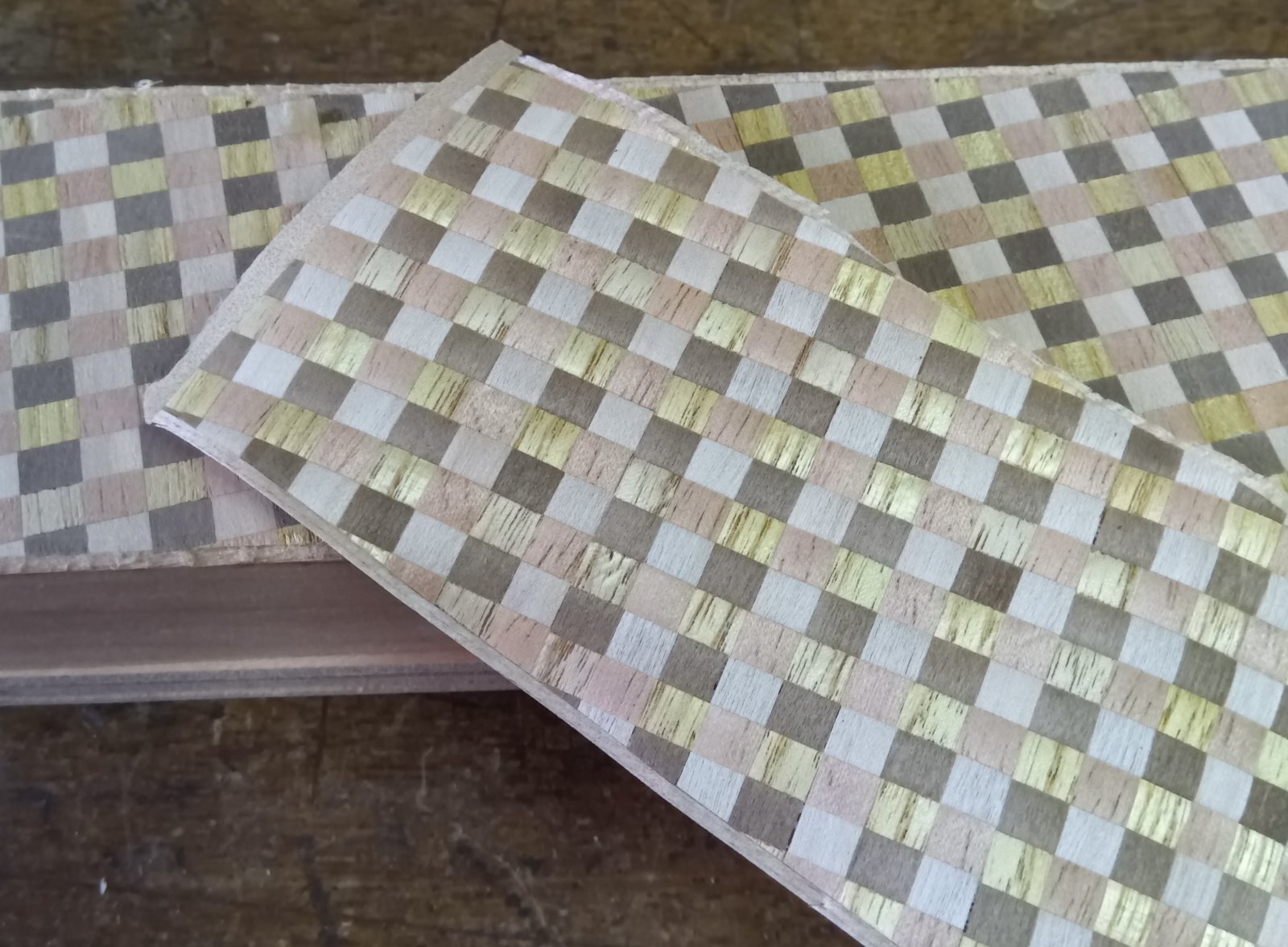
Today, I also finished the block for the four-color ichimatsu yosegi sheet that I wrote about a few days ago. I have not started slicing it yet, but I tried slicing one sheet as a test (photo). Depending on the thickness of the sheets, about 150 to 200 sheets can be sliced from this block. I slice them a little thicker, so the number is a bit lower. I am thinking about doing the full slicing work on a day when the weather is slightly bad and the humidity is higher.
A week has already passed since the first working day of January. In Japan, we will have a three-day weekend starting tomorrow. Monday is a national holiday called Coming of Age Day. I hope you have a wonderful weekend 😊
The glue used for yosegi and for making the boxes is water-based, and manufacturers sell many different types with different amounts of water in them. Among these, it is important to use a glue that has enough moisture and is not too hard when attaching yosegi sheets to a board. By doing this, the glue can soak slightly into the yosegi sheet and bond it more firmly to the board. If a harder glue is used and it only sticks on the surface, the sheet can come off when strong force is applied, for example during cutting or other work with tools. I followed the same approach this time as well, but there were still a few small areas where the surface peeled slightly. Because of the direction of the wood grain, this pattern is more likely to peel. However, at this stage of the process, it is easy to repair and restore it to its original condition. Of course, it does take some extra time and effort...😅
Today, I also finished the block for the four-color ichimatsu yosegi sheet that I wrote about a few days ago. I have not started slicing it yet, but I tried slicing one sheet as a test (photo). Depending on the thickness of the sheets, about 150 to 200 sheets can be sliced from this block. I slice them a little thicker, so the number is a bit lower. I am thinking about doing the full slicing work on a day when the weather is slightly bad and the humidity is higher.
A week has already passed since the first working day of January. In Japan, we will have a three-day weekend starting tomorrow. Monday is a national holiday called Coming of Age Day. I hope you have a wonderful weekend 😊