Stability of checkered pattern yosegi
Today was cloudy again, and it rained a little in the morning. I worked on the finishing process for the 6-sun puzzle boxes from the morning, and I’m glad that the assembly was completed safely. I just made a limited 18-step model the other day, but the 6-sun puzzle boxes still need a lot of care in many areas. Once again, I felt that for Japanese puzzle boxes, panels can become too large at this size. Thin panels used in puzzle boxes feel a bit too big at the 6-sun size. I think sizes up to around 5-sun puzzle boxes are safer and more stable. For customers who purchase larger puzzle boxes, I believe it is better to take extra care in how they are stored. They are more easily affected by outside air and the environment. This time, all surfaces were covered with yosegi sheets, so that was a good point.
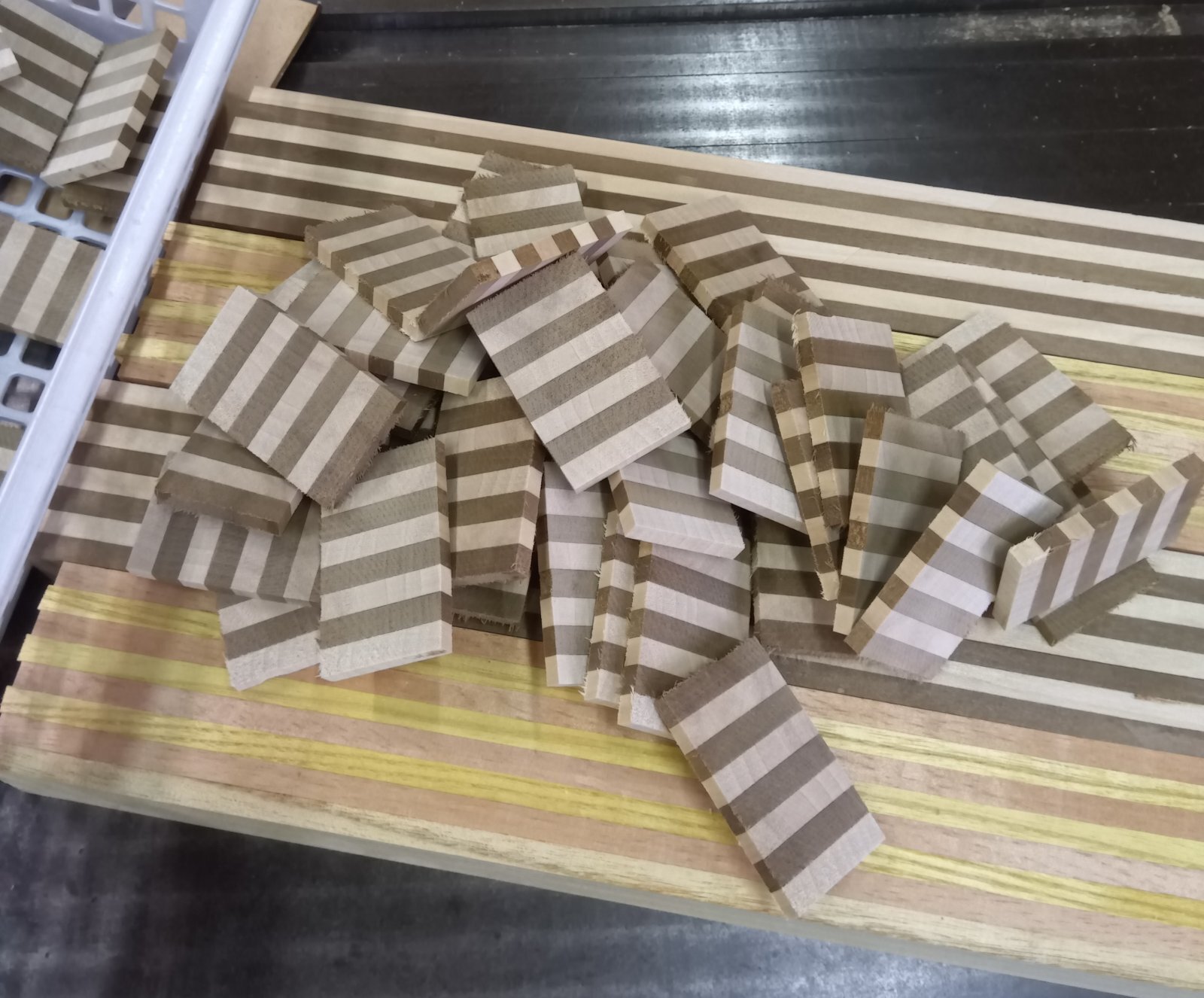
In addition, today I continued making checkered pattern yosegi (ichimatsu) sheets for the side panels. I am currently working on two different types. One is a sheet with four colors arranged diagonally, and the other is a sheet with two colors arranged vertically. Recently, I have been using this checkerboard yosegi sheet more often. I do not use solid wood side panels very much these days, even though the walnut type is quite popular. Around seasonal changes, the temperature and humidity change a lot, so solid wood types have more risk. Simply put, they warp more easily. Lately, the air has been especially dry, so I need to be very careful. In that sense, this checkerboard yosegi sheet works very well to prevent warping. The main reason is that the wood grain crosses. The base panel has wood grain running sideways, but this checkerboard pattern, especially the type arranged vertically, has grain running up and down. Because of this, the grains cross each other like a plus sign. Wood usually warps in a direction parallel to the grain, so the grain of this sheet helps stop the panel from warping. Of course, there is a limit. If the sheet is too thick, the force of the sheet itself can pull the panel and cause too much warping. Finding the right balance is very important. This idea of crossing wood grain or changing its direction to reduce warping and shrinking is used in several places in the structure of Japanese puzzle boxes.
In addition, today I continued making checkered pattern yosegi (ichimatsu) sheets for the side panels. I am currently working on two different types. One is a sheet with four colors arranged diagonally, and the other is a sheet with two colors arranged vertically. Recently, I have been using this checkerboard yosegi sheet more often. I do not use solid wood side panels very much these days, even though the walnut type is quite popular. Around seasonal changes, the temperature and humidity change a lot, so solid wood types have more risk. Simply put, they warp more easily. Lately, the air has been especially dry, so I need to be very careful. In that sense, this checkerboard yosegi sheet works very well to prevent warping. The main reason is that the wood grain crosses. The base panel has wood grain running sideways, but this checkerboard pattern, especially the type arranged vertically, has grain running up and down. Because of this, the grains cross each other like a plus sign. Wood usually warps in a direction parallel to the grain, so the grain of this sheet helps stop the panel from warping. Of course, there is a limit. If the sheet is too thick, the force of the sheet itself can pull the panel and cause too much warping. Finding the right balance is very important. This idea of crossing wood grain or changing its direction to reduce warping and shrinking is used in several places in the structure of Japanese puzzle boxes.