Unwanted peeling of Yosegi sheets
Today the weather was nice again, and it felt warm during the day. The difference between the morning and evening temperatures is big, and the air is very dry, so I have to be careful about the panels warping. I worked in my workshop all day today. There was a small problem with the 6-sun boxes, so the schedule has been delayed by one day. I am still moving forward, and these boxes are planned to be listed next week.
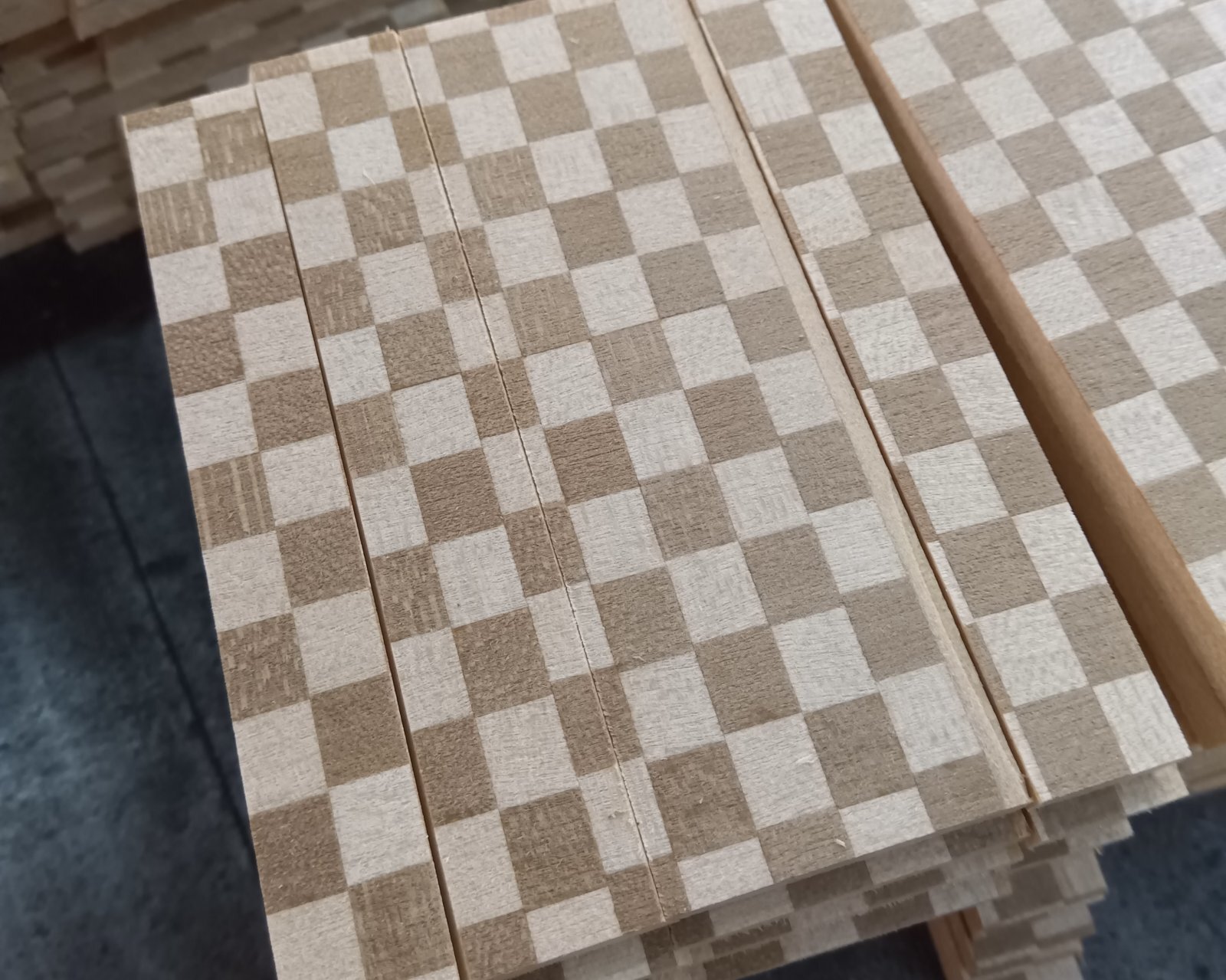
One of the tasks I worked on today was making the sliding key panel. The panel in the photo is for the 4-sun puzzle boxes I am making now, and it uses checkered yosegi. This checkered yosegi is made a little thicker to improve the color of the pattern. Even though “thicker” only means going from 0.15 mm to 0.2 mm or 0.25 mm, the color of the wood changes quite a lot. You can also feel the difference easily when you hold it. I cut this panel to the required size, then cut it into three pieces to make the sliding key parts. When I cut it from the top side (the patterned side), there is no problem. But when I cut it from the bottom side, meaning with the pattern facing down, sometimes the pattern peels off.
The way of making this part is different depending on the craftsperson, so it doesn’t mean all puzzle boxes are made like this, but this is how I do it. In other words, there are times when I have to cut the panel with the patterned side facing down. The checkered yosegi sheet is firmly glued onto the wood board, so you cannot peel it off by hand. But a woodworking machine has much stronger force, and even if it does not peel the whole sheet, it can peel off part of it. When it peels, it does not come off cleanly. It breaks in a jagged, chipped way. Once this happens, it is very hard to repair, and it can never return to its original condition. And because the peeling happens exactly on the cut line, the position of the sliding key becomes easy to see. In any case, this is not good for a product.
As far as I know, there are two ways to prevent this. One is to use a very sharp saw, and the other is to use a backing board. These methods may seem obvious to someone with woodworking experience, but I always pay attention to them because I want a clean finish. A backing board means placing another panel, similar to the sliding key panel, underneath the piece you are cutting. By doing this, you can stop the force that tries to peel the pattern downward.
However, there is one important condition. The two panels must have no gap between them, and the lower panel must be exactly the same as the upper one. If they are not the same, the peeling cannot be prevented.
One of the tasks I worked on today was making the sliding key panel. The panel in the photo is for the 4-sun puzzle boxes I am making now, and it uses checkered yosegi. This checkered yosegi is made a little thicker to improve the color of the pattern. Even though “thicker” only means going from 0.15 mm to 0.2 mm or 0.25 mm, the color of the wood changes quite a lot. You can also feel the difference easily when you hold it. I cut this panel to the required size, then cut it into three pieces to make the sliding key parts. When I cut it from the top side (the patterned side), there is no problem. But when I cut it from the bottom side, meaning with the pattern facing down, sometimes the pattern peels off.
The way of making this part is different depending on the craftsperson, so it doesn’t mean all puzzle boxes are made like this, but this is how I do it. In other words, there are times when I have to cut the panel with the patterned side facing down. The checkered yosegi sheet is firmly glued onto the wood board, so you cannot peel it off by hand. But a woodworking machine has much stronger force, and even if it does not peel the whole sheet, it can peel off part of it. When it peels, it does not come off cleanly. It breaks in a jagged, chipped way. Once this happens, it is very hard to repair, and it can never return to its original condition. And because the peeling happens exactly on the cut line, the position of the sliding key becomes easy to see. In any case, this is not good for a product.
As far as I know, there are two ways to prevent this. One is to use a very sharp saw, and the other is to use a backing board. These methods may seem obvious to someone with woodworking experience, but I always pay attention to them because I want a clean finish. A backing board means placing another panel, similar to the sliding key panel, underneath the piece you are cutting. By doing this, you can stop the force that tries to peel the pattern downward.
However, there is one important condition. The two panels must have no gap between them, and the lower panel must be exactly the same as the upper one. If they are not the same, the peeling cannot be prevented.