Price and production quantity
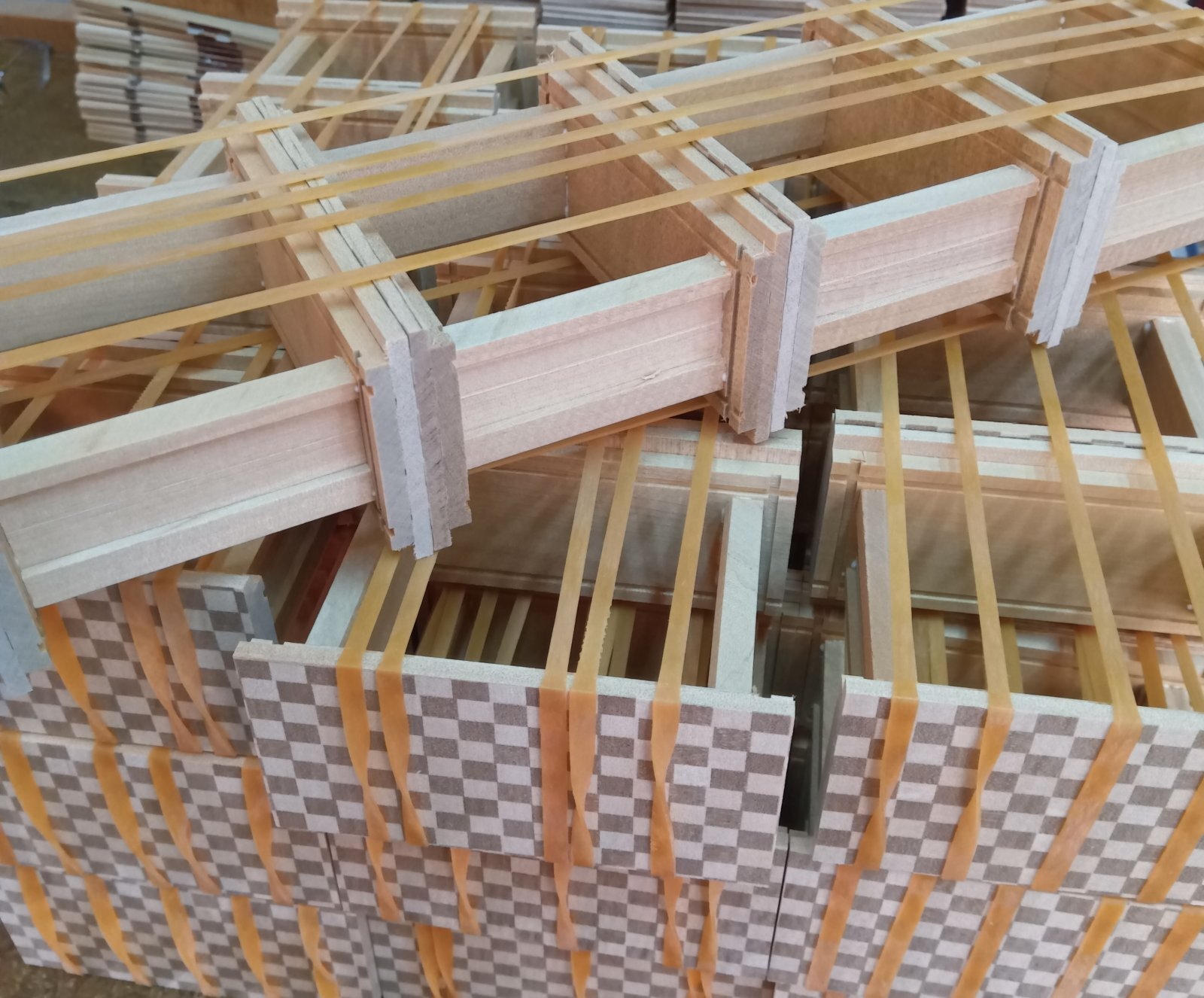
It was sunny again today, but the morning was very cold, and the whole day felt chilly. It really feels like the end of the year now. I spent the day working in my workshop again. At the moment, I am making the 6-sun boxes and the 4-sun boxes at the same time. Today I also prepared the bottom panels for the 6-sun boxes, but I need to wait until they are completely dry. So I mainly worked on the 4-sun boxes. The frame parts that were half-finished are now completed, and I assembled them a little while ago.
From the 18-steps puzzle boxes and up, the Aruki moving panels on the bottom can also move, so the whole structure of the box is supported only by the side panels and the axis panels of the frame. If these are not glued firmly, the box will fall apart. Since puzzle boxes have moving mechanisms, they need to be even stronger than normal storage boxes. When I assemble this frame, I always pay attention so that the glue does not become too little. If I put more glue, sometimes it squeezes out, but I actually welcome that, because it makes the box stronger. So maybe having a little glue overflow is a good point.
The glue is water-based. It looks white when wet, but it becomes clear when dry, so the extra glue does not bother me too much. But after drying, it becomes like a thin plastic film, and it does not slide well at all. That is why I must never get glue inside the groove where the Aruki panel moves. Also, if glue hardens in the places where internal parts need to be attached, the parts cannot be placed in the correct position. So whenever glue overflows into those inner areas, I always wipe it off.
This time I am making forty boxes, and the design has now been decided. I chose a combination of traditional yosegi and solid wood panels, and only the top panels will use the traditional yosegi. It may be a slightly unusual way to use yosegi. All forty boxes will have the same design. As I wrote yesterday, the side panels have a checkered pattern arranged horizontally (or vertically), as shown in the photo.
When I make forty or fifty boxes, you could say it is more like mass production. The 6-sun boxes I am making now feel more like “art pieces,” and their design cannot be made a second time. If I can make many boxes quickly, the cost becomes lower. This allows me to create boxes that are suitable for wholesale. Puzzle boxes in Hakone have long been sold as souvenirs, so this kind of production style has been used for many years. I also follow this method as much as I can. Very detailed designs become expensive and cannot be mass-produced, so I always try to keep a good balance between cost and design.
Have a great weekend!😄
From the 18-steps puzzle boxes and up, the Aruki moving panels on the bottom can also move, so the whole structure of the box is supported only by the side panels and the axis panels of the frame. If these are not glued firmly, the box will fall apart. Since puzzle boxes have moving mechanisms, they need to be even stronger than normal storage boxes. When I assemble this frame, I always pay attention so that the glue does not become too little. If I put more glue, sometimes it squeezes out, but I actually welcome that, because it makes the box stronger. So maybe having a little glue overflow is a good point.
The glue is water-based. It looks white when wet, but it becomes clear when dry, so the extra glue does not bother me too much. But after drying, it becomes like a thin plastic film, and it does not slide well at all. That is why I must never get glue inside the groove where the Aruki panel moves. Also, if glue hardens in the places where internal parts need to be attached, the parts cannot be placed in the correct position. So whenever glue overflows into those inner areas, I always wipe it off.
This time I am making forty boxes, and the design has now been decided. I chose a combination of traditional yosegi and solid wood panels, and only the top panels will use the traditional yosegi. It may be a slightly unusual way to use yosegi. All forty boxes will have the same design. As I wrote yesterday, the side panels have a checkered pattern arranged horizontally (or vertically), as shown in the photo.
When I make forty or fifty boxes, you could say it is more like mass production. The 6-sun boxes I am making now feel more like “art pieces,” and their design cannot be made a second time. If I can make many boxes quickly, the cost becomes lower. This allows me to create boxes that are suitable for wholesale. Puzzle boxes in Hakone have long been sold as souvenirs, so this kind of production style has been used for many years. I also follow this method as much as I can. Very detailed designs become expensive and cannot be mass-produced, so I always try to keep a good balance between cost and design.
Have a great weekend!😄