Design and Movement
The rainy weather returned today. A typhoon is forecast to approach this weekend, so it looks like we will have more bad weather for a while. I made some progress on the 5-sun 36-step puzzle boxes yesterday, but I have put that work on hold again. Today, I began working fully on the Square puzzle boxes. During the morning, I made and assembled the frame panels. In the afternoon, I made the Aruki sliding panels. This is a smaller batch, so I think the work will move a little faster.
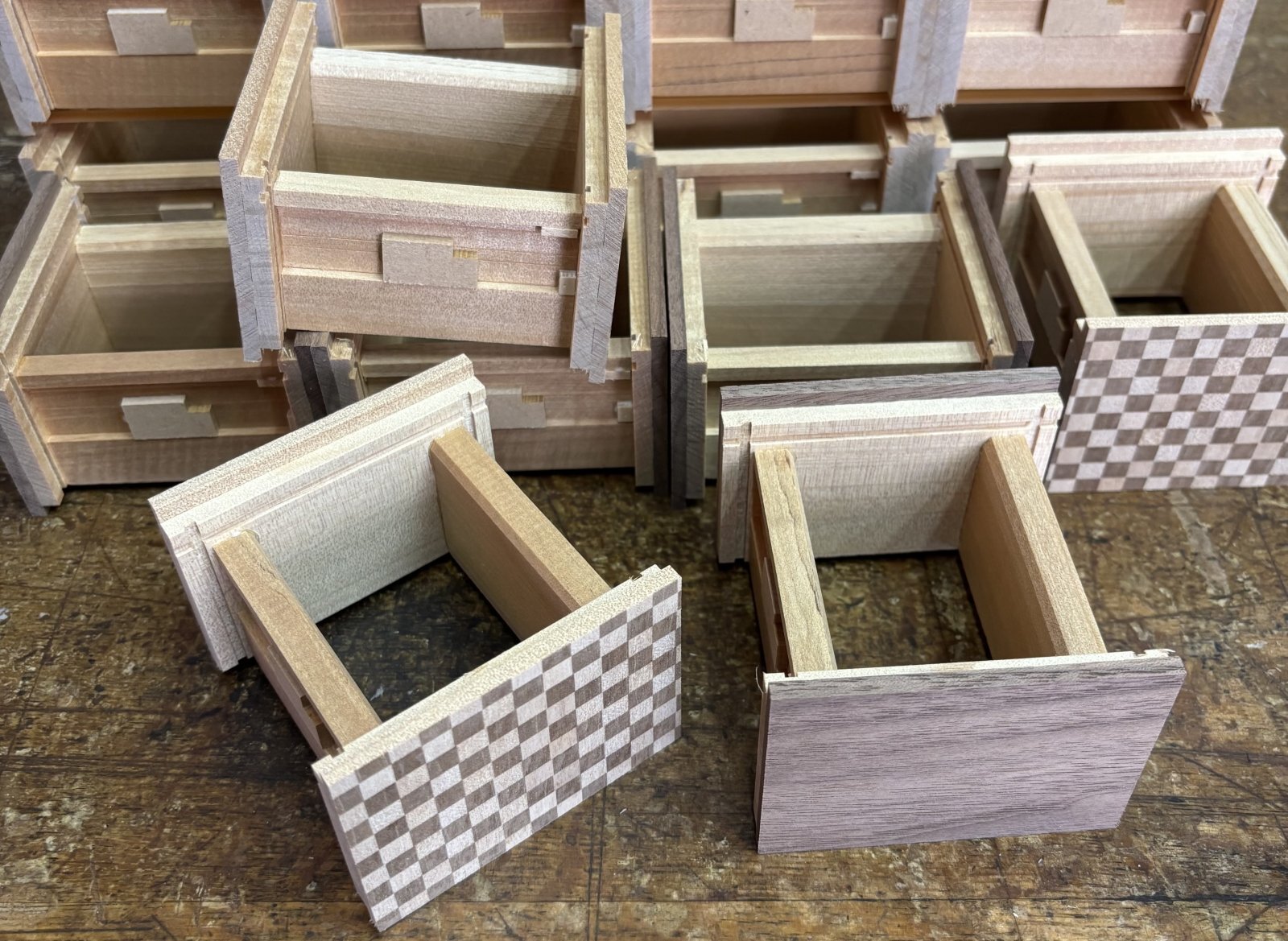
The photo shows the Square puzzle boxes after assembly, just before the Aruki sliding panels are attached. This batch includes a few Walnut versions, but most of the boxes have checkered Yosegi side panels. When making the Aruki panels, it is important to consider what material is attached to the side panels. In this batch, the checkered Yosegi side panels are more flexible than the Walnut panels, and this difference has some effect when fitting the Aruki panels. The Walnut version has a narrower range of flexibility, so the adjustment needs to be more precise. If the panel movement becomes too loose, it often cannot be returned to its previous condition. When two types of side panels are mixed in the same batch, as they are this time, making all the Aruki panels in exactly the same way can result in slight differences in movement. When that happens, I make the necessary adjustments while attaching them. The movement of an Aruki panel is determined by several different factors. It is not only the thickness of the panel’s legs that matters. The way the panel makes contact with the body is also very important.
The next step will be attaching the top and bottom panels, but those panels are not finished yet, so I still need to make them. The solid wood panels that I posted on social media yesterday only need to be cut to size. However, I still need to create the patterns for the random wood grain versions. I plan to use three colors this time, but I am still thinking about the design. At first, I considered making a vertical pattern, but I am also thinking about breaking up the straight lines and arranging the pieces at an angle. I will probably make a sample first and then decide. What I imagine in my head often looks quite different once I actually make it...🤔
The photo shows the Square puzzle boxes after assembly, just before the Aruki sliding panels are attached. This batch includes a few Walnut versions, but most of the boxes have checkered Yosegi side panels. When making the Aruki panels, it is important to consider what material is attached to the side panels. In this batch, the checkered Yosegi side panels are more flexible than the Walnut panels, and this difference has some effect when fitting the Aruki panels. The Walnut version has a narrower range of flexibility, so the adjustment needs to be more precise. If the panel movement becomes too loose, it often cannot be returned to its previous condition. When two types of side panels are mixed in the same batch, as they are this time, making all the Aruki panels in exactly the same way can result in slight differences in movement. When that happens, I make the necessary adjustments while attaching them. The movement of an Aruki panel is determined by several different factors. It is not only the thickness of the panel’s legs that matters. The way the panel makes contact with the body is also very important.
The next step will be attaching the top and bottom panels, but those panels are not finished yet, so I still need to make them. The solid wood panels that I posted on social media yesterday only need to be cut to size. However, I still need to create the patterns for the random wood grain versions. I plan to use three colors this time, but I am still thinking about the design. At first, I considered making a vertical pattern, but I am also thinking about breaking up the straight lines and arranging the pieces at an angle. I will probably make a sample first and then decide. What I imagine in my head often looks quite different once I actually make it...🤔