The Advantage of Vertical Patterns
This week has brought the kind of sunny weather that feels like summer again. Sunshine lowers the humidity, making it much easier to attach the panels, so I am always grateful for days like this. Thanks to the good weather today, I was able to attach the sliding key panels. Before that, I also spent some time preparing for the next production run.
Next, I will be making another batch of 4-sun 14-step puzzle boxes. They were not originally in my production plan, but as I mentioned in a recent post, I decided to make them after all 🤣 Most of them will have the traditional Yosegi top panel, but I am also planning to make about ten boxes with a limited design. I have not decided on that special top panel yet. I spent some time thinking about it again today, but I still have not made up my mind. This morning, I prepared the materials for the new batch. Every box in this batch will have a Walnut veneer bottom panel, and today I also attached those panels. I considered using Rosewood instead, but I wanted to keep the same design as the previous batch. Walnut also seems to be more popular than Rosewood, so I decided to use it again. Unlike traditional Yosegi sheets, these Walnut veneer panels are left overnight after being attached and are then heat-pressed to complete the bonding.
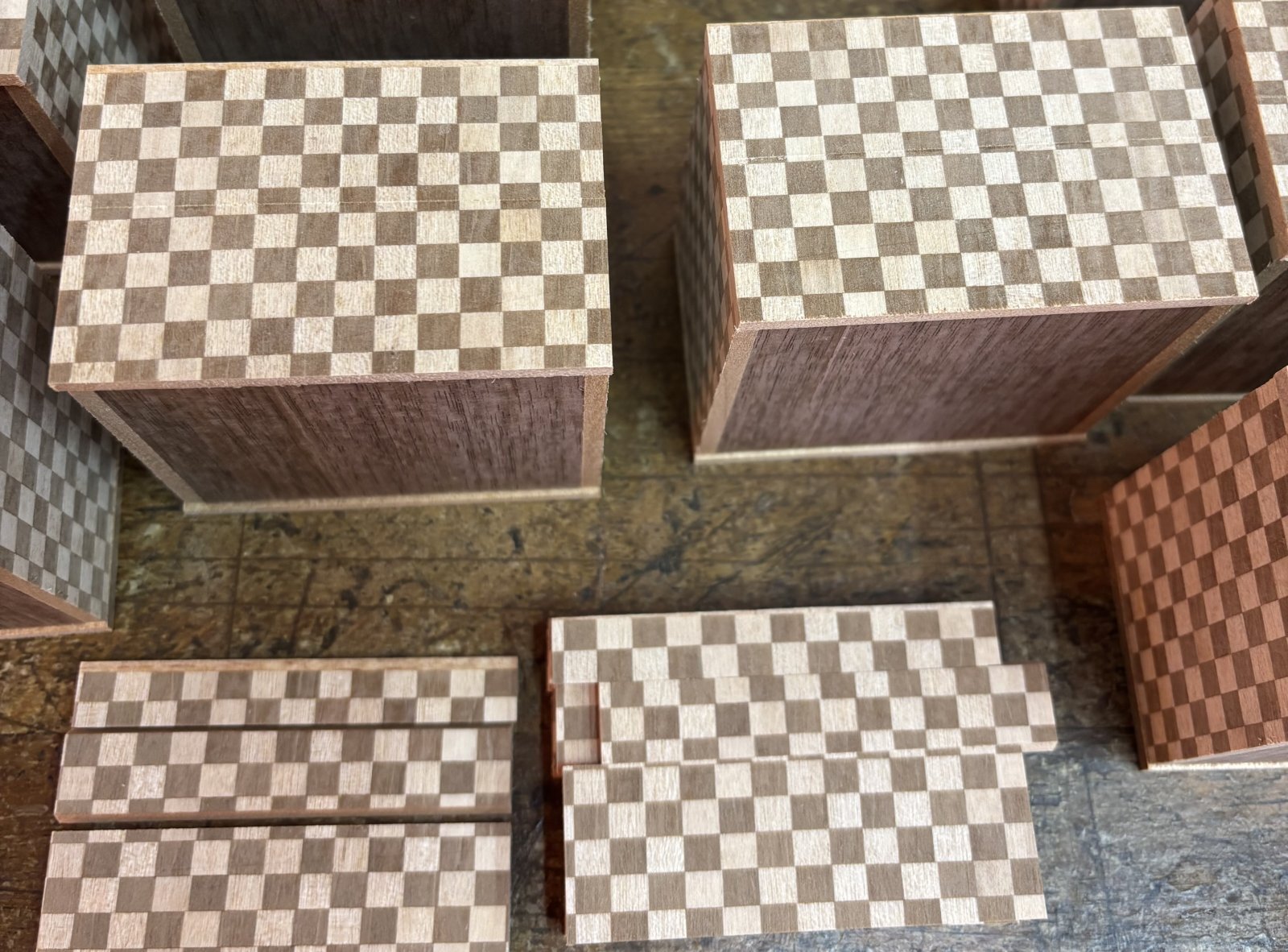
Later in the afternoon, when the humidity dropped even further, I attached the sliding key panels to the Square puzzle boxes. With that, the assembly of this batch was complete. The photo shows the two-color checkered Yosegi pattern used on most of the boxes in this batch. The most distinctive feature of this pattern is that the lines run vertically at 90 degrees. In practice, however, this type of Yosegi sheet is a little more difficult to work with. The biggest challenge is that even a slight misalignment is easy to notice. First, the sheet is attached by hand to a roughly cut wooden panel. It is then cut to its final size and attached to the box. During these steps, the pattern can gradually shift so that it is no longer perfectly vertical. Of course, the Yosegi sheet itself is made from wood and is not perfectly aligned to begin with, so absolute perfection is impossible. Even so, I try to keep the pattern as straight as possible. With diagonally arranged Yosegi patterns, these small changes are much less noticeable.
However, the vertical checkered pattern has one important advantage. It helps hide the slight pattern mismatch that naturally appears around the sliding key. No matter what pattern is used, a small amount of the design is removed by the thickness of the saw blade, so a slight mismatch cannot be avoided. With this checkered pattern, however, the vertical lines stay in the same position even if they become slightly shorter. As a result, the sliding key is much less noticeable at first glance. Natural wood has the same advantage and is excellent for hiding the position of the sliding key. This checkered pattern offers a similar benefit, provided that the pattern is carefully aligned when it is attached.
Next, I will be making another batch of 4-sun 14-step puzzle boxes. They were not originally in my production plan, but as I mentioned in a recent post, I decided to make them after all 🤣 Most of them will have the traditional Yosegi top panel, but I am also planning to make about ten boxes with a limited design. I have not decided on that special top panel yet. I spent some time thinking about it again today, but I still have not made up my mind. This morning, I prepared the materials for the new batch. Every box in this batch will have a Walnut veneer bottom panel, and today I also attached those panels. I considered using Rosewood instead, but I wanted to keep the same design as the previous batch. Walnut also seems to be more popular than Rosewood, so I decided to use it again. Unlike traditional Yosegi sheets, these Walnut veneer panels are left overnight after being attached and are then heat-pressed to complete the bonding.
Later in the afternoon, when the humidity dropped even further, I attached the sliding key panels to the Square puzzle boxes. With that, the assembly of this batch was complete. The photo shows the two-color checkered Yosegi pattern used on most of the boxes in this batch. The most distinctive feature of this pattern is that the lines run vertically at 90 degrees. In practice, however, this type of Yosegi sheet is a little more difficult to work with. The biggest challenge is that even a slight misalignment is easy to notice. First, the sheet is attached by hand to a roughly cut wooden panel. It is then cut to its final size and attached to the box. During these steps, the pattern can gradually shift so that it is no longer perfectly vertical. Of course, the Yosegi sheet itself is made from wood and is not perfectly aligned to begin with, so absolute perfection is impossible. Even so, I try to keep the pattern as straight as possible. With diagonally arranged Yosegi patterns, these small changes are much less noticeable.
However, the vertical checkered pattern has one important advantage. It helps hide the slight pattern mismatch that naturally appears around the sliding key. No matter what pattern is used, a small amount of the design is removed by the thickness of the saw blade, so a slight mismatch cannot be avoided. With this checkered pattern, however, the vertical lines stay in the same position even if they become slightly shorter. As a result, the sliding key is much less noticeable at first glance. Natural wood has the same advantage and is excellent for hiding the position of the sliding key. This checkered pattern offers a similar benefit, provided that the pattern is carefully aligned when it is attached.