Handling Thin Wooden Panels
Today was another very hot day. Yesterday, the temperature seems to have reached around 35°C, and today was probably about the same. Many places around the world are also experiencing extreme heat, so please take care.
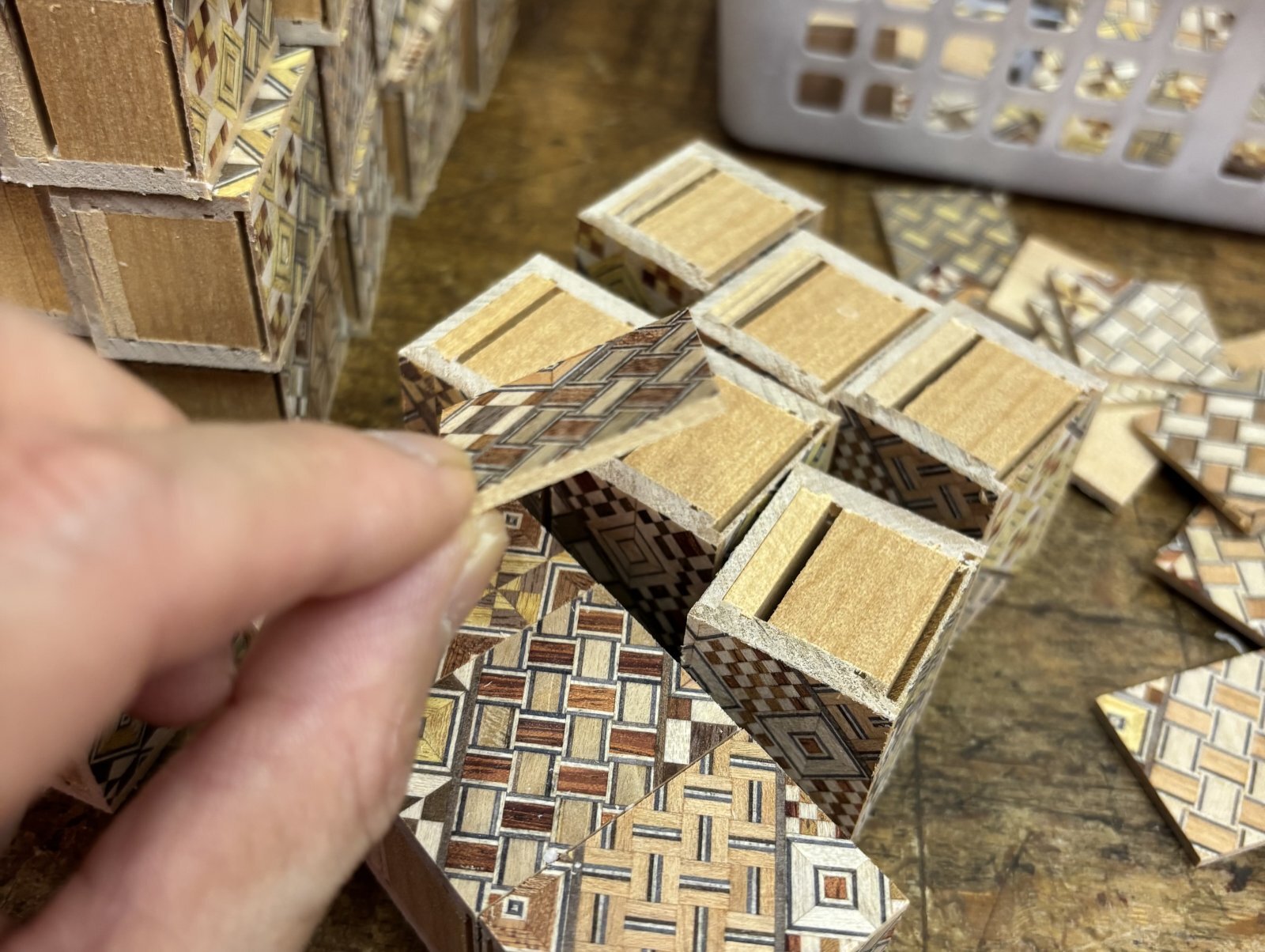
Today, I attached panels to the Mame puzzle boxes. This was the final side, the Aruki side panel. Since the surface is very small, I have to be extremely careful when applying the glue. Of course, the same is true for the other sides, but if the glue squeezes out, it can cause the mechanism to stick. This surface is even smaller, so the glue is more likely to squeeze out. Using too much glue also increases the risk of the panel warping, so it is very important to use the correct amount. The panel is only about 2 mm thick, so even a small amount of moisture can make it warp very quickly. Since glue also contains moisture, I have to be careful. The panel warps away from the side where the glue is applied. If this happens, a gap can appear between the box body and the side panel, making the finished box look unattractive.
When I look at old puzzle boxes, I am surprised by how little the side panels have warped. I do not know whether this is simply by chance or not. Many top panels are badly warped even though they have a larger glued surface, while the side panels often show relatively little warping. Perhaps this is due to the quality of the wood. They were sometimes made from high-quality, straight-grained Katsura, and sufficient natural drying may also have played an important role. I also wondered whether the animal glue used at that time was better. However, I have heard that it contains more moisture than modern woodworking glue, and it is also applied hot 🤣, so neither of these seems to be an advantage. There may have been some special technique in the way the glue was applied. For now, I use what I believe is the best method based on these observations. There are many types of glue, and a few years ago I changed to one specifically for attaching panels like these. So far, the results seem to be good.
Today, I attached panels to the Mame puzzle boxes. This was the final side, the Aruki side panel. Since the surface is very small, I have to be extremely careful when applying the glue. Of course, the same is true for the other sides, but if the glue squeezes out, it can cause the mechanism to stick. This surface is even smaller, so the glue is more likely to squeeze out. Using too much glue also increases the risk of the panel warping, so it is very important to use the correct amount. The panel is only about 2 mm thick, so even a small amount of moisture can make it warp very quickly. Since glue also contains moisture, I have to be careful. The panel warps away from the side where the glue is applied. If this happens, a gap can appear between the box body and the side panel, making the finished box look unattractive.
When I look at old puzzle boxes, I am surprised by how little the side panels have warped. I do not know whether this is simply by chance or not. Many top panels are badly warped even though they have a larger glued surface, while the side panels often show relatively little warping. Perhaps this is due to the quality of the wood. They were sometimes made from high-quality, straight-grained Katsura, and sufficient natural drying may also have played an important role. I also wondered whether the animal glue used at that time was better. However, I have heard that it contains more moisture than modern woodworking glue, and it is also applied hot 🤣, so neither of these seems to be an advantage. There may have been some special technique in the way the glue was applied. For now, I use what I believe is the best method based on these observations. There are many types of glue, and a few years ago I changed to one specifically for attaching panels like these. So far, the results seem to be good.