Assembled Aruki Panels
We had another sunny day today, and the temperature continued to rise. Unfortunately, the humidity was also very high, which made it quite a tiring day. When both the temperature and humidity are high, it really puts a strain on the body. Around noon, the humidity dropped a little, so I took the opportunity to work on the special-order boxes that had been on hold. Today's task was preparing the box bodies for the attachment of the sliding key panels. This involves carefully machining the surface of the box so that it is perfectly flat and ready for the panels to be attached. The small internal wooden blocks (bocchi) had already been installed, so the boxes were machined with those parts already in place. Although a machine is used for this process, the amount of material removed is controlled entirely by hand. It requires a delicate touch and many years of experience. These particular boxes have a high-step mechanism, making the process even more demanding, and the way I use the machine is slightly different from usual. I spent about two hours on this work, and fortunately everything went well. In the afternoon, I attached the first sliding key panel. One side still remains to be attached. However, rain is expected tomorrow, so I have not yet decided whether to continue with the gluing process. At the same time, leaving the boxes unfinished for too long is not ideal either, so it is not an easy decision.
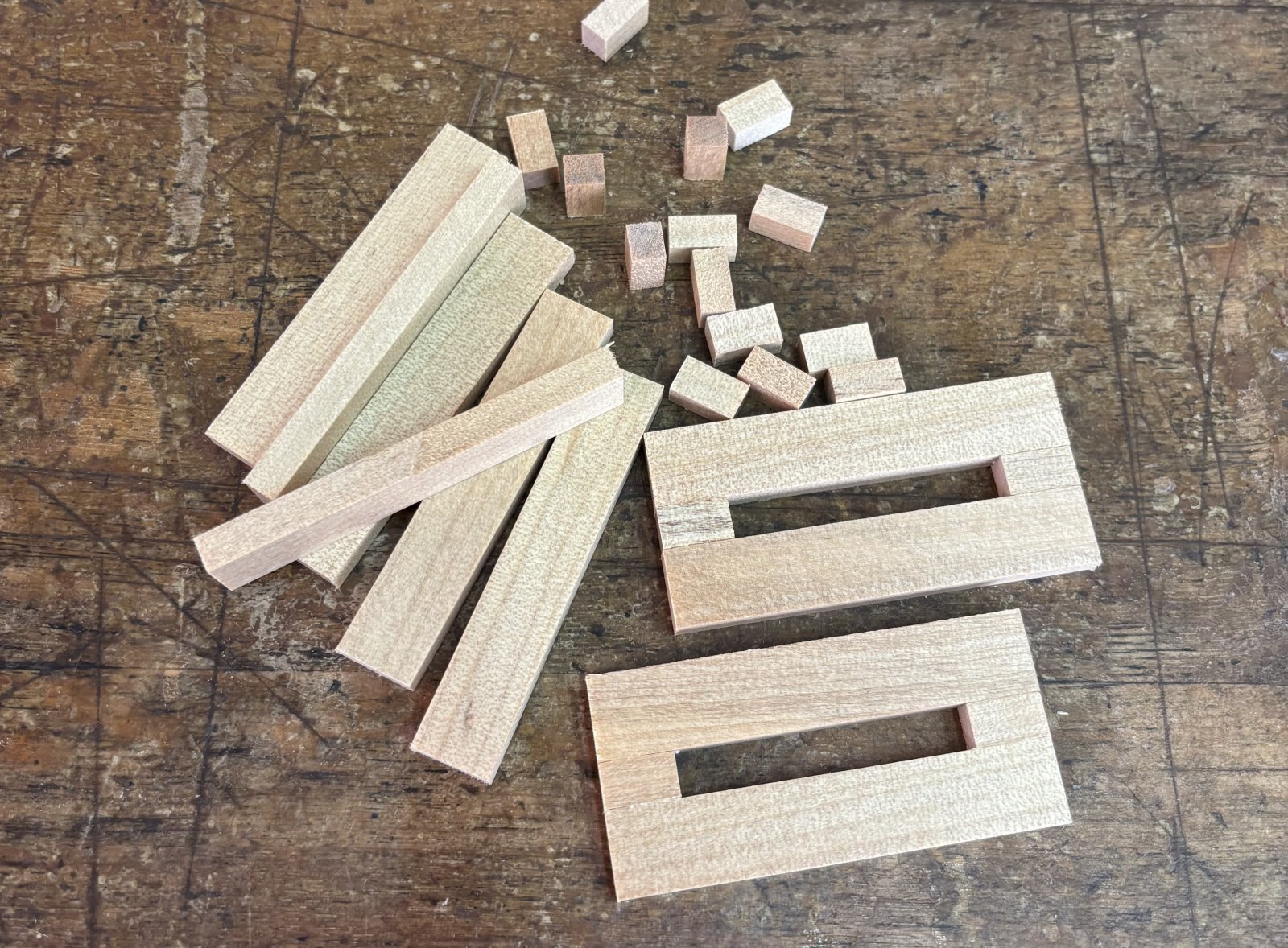
I spent most of the day working on the special-order boxes, but I was also able to make a little progress on the 4-Compartment Boxes. I finished assembling the remaining Aruki sliding panels and also cut some panels for a small number of random-grain versions that I am planning to make this time. There will only be a few of them, but I think they will be quite interesting. The photo shows few of the side Aruki panels. As I mentioned yesterday, these panels are different from those used in a standard Japanese puzzle box. Instead of being made from a single piece of wood, each panel is assembled from four separate parts. It is a special panel designed specifically for this box.
In a standard Japanese puzzle box, the small internal wooden block, known as a bocchi, moves within the slot in the center of the panel. It usually starts at the far left and gradually moves to the right. Each time it moves, the side panel itself also moves downward one step, alternating with the movement of the bocchi. In some cases, the bocchi may even move back toward the left during the sequence. In this box, however, the bocchi starts in the center. Since the mechanism is designed to move in both directions from the very beginning, the structure must be different. It might seem that a single slot with the bocchi positioned in the center would be enough, but that would make the Aruki panel much weaker. To maintain sufficient strength, the panel is designed with fixed sections on both the left and right sides, resulting in the four-piece construction shown in the photo. The thickness of this panel is fixed at 6 mm, and the grooves in the box body have already been made to match that dimension. For that reason, when assembling the four parts, I have to be careful to avoid even the slightest step or misalignment between them.
Speaking of this panel design, I was surprised when I recently came across an old Japanese puzzle box—probably around 50~60 years old—that used an Aruki panel built in much the same way. If I remember correctly, it was an ordinary 10-step puzzle box or something similar. However, instead of using the more common Aruki panel with a slot on one side, the craftsman had used a panel that appeared to be assembled from multiple parts, with an opening in the center, much like the one shown here. That craftsman must have preferred this method of construction. Perhaps it was a technique he developed on his own. It is fascinating to see that even back then, different craftsmen had their own approaches and ways of building puzzle boxes.
Have a nice weekend!😊
I spent most of the day working on the special-order boxes, but I was also able to make a little progress on the 4-Compartment Boxes. I finished assembling the remaining Aruki sliding panels and also cut some panels for a small number of random-grain versions that I am planning to make this time. There will only be a few of them, but I think they will be quite interesting. The photo shows few of the side Aruki panels. As I mentioned yesterday, these panels are different from those used in a standard Japanese puzzle box. Instead of being made from a single piece of wood, each panel is assembled from four separate parts. It is a special panel designed specifically for this box.
In a standard Japanese puzzle box, the small internal wooden block, known as a bocchi, moves within the slot in the center of the panel. It usually starts at the far left and gradually moves to the right. Each time it moves, the side panel itself also moves downward one step, alternating with the movement of the bocchi. In some cases, the bocchi may even move back toward the left during the sequence. In this box, however, the bocchi starts in the center. Since the mechanism is designed to move in both directions from the very beginning, the structure must be different. It might seem that a single slot with the bocchi positioned in the center would be enough, but that would make the Aruki panel much weaker. To maintain sufficient strength, the panel is designed with fixed sections on both the left and right sides, resulting in the four-piece construction shown in the photo. The thickness of this panel is fixed at 6 mm, and the grooves in the box body have already been made to match that dimension. For that reason, when assembling the four parts, I have to be careful to avoid even the slightest step or misalignment between them.
Speaking of this panel design, I was surprised when I recently came across an old Japanese puzzle box—probably around 50~60 years old—that used an Aruki panel built in much the same way. If I remember correctly, it was an ordinary 10-step puzzle box or something similar. However, instead of using the more common Aruki panel with a slot on one side, the craftsman had used a panel that appeared to be assembled from multiple parts, with an opening in the center, much like the one shown here. That craftsman must have preferred this method of construction. Perhaps it was a technique he developed on his own. It is fascinating to see that even back then, different craftsmen had their own approaches and ways of building puzzle boxes.
Have a nice weekend!😊