Non-Standard Sliding Mechanism
It rained from the morning today, and the rain came and went throughout the day. It was the kind of weather that is typical during the rainy season. As a result, the humidity was quite high, and many of the wooden parts were probably absorbing moisture from the air. On a day like this, assembling puzzle boxes can be risky.
As I mentioned a little while ago, yosegi likes humidity. Because of that, a day like this can be a good time to work with yosegi. I had planned to glue the yosegi sheets onto the panels today, and the timing worked out well. Then again, with the rainy season now underway, we will probably have many days like this for a while...haha. I decided to do the gluing in the afternoon, so during the morning I spent some time preparing the new puzzle box that I mentioned yesterday. This is a project that I started somewhat spontaneously, but I had actually been thinking about the mechanism for several days. At the same time, I had also been considering how to use the yosegi sheets that will be used for this project. Another reason is that I wanted to use the sheets before they became too dry from being stored for a long time. Normally, yosegi sheets have a thin wooden border around all four sides. This helps keep the pattern together and prevents the individual pieces from coming apart. The sheets I am using this time are leftovers from a previous project, so they were cut at the sheet stage. As a result, one side no longer has that border. Because of this, the pattern along that edge has become a little loose, so I would prefer to use the sheets sooner rather than later.
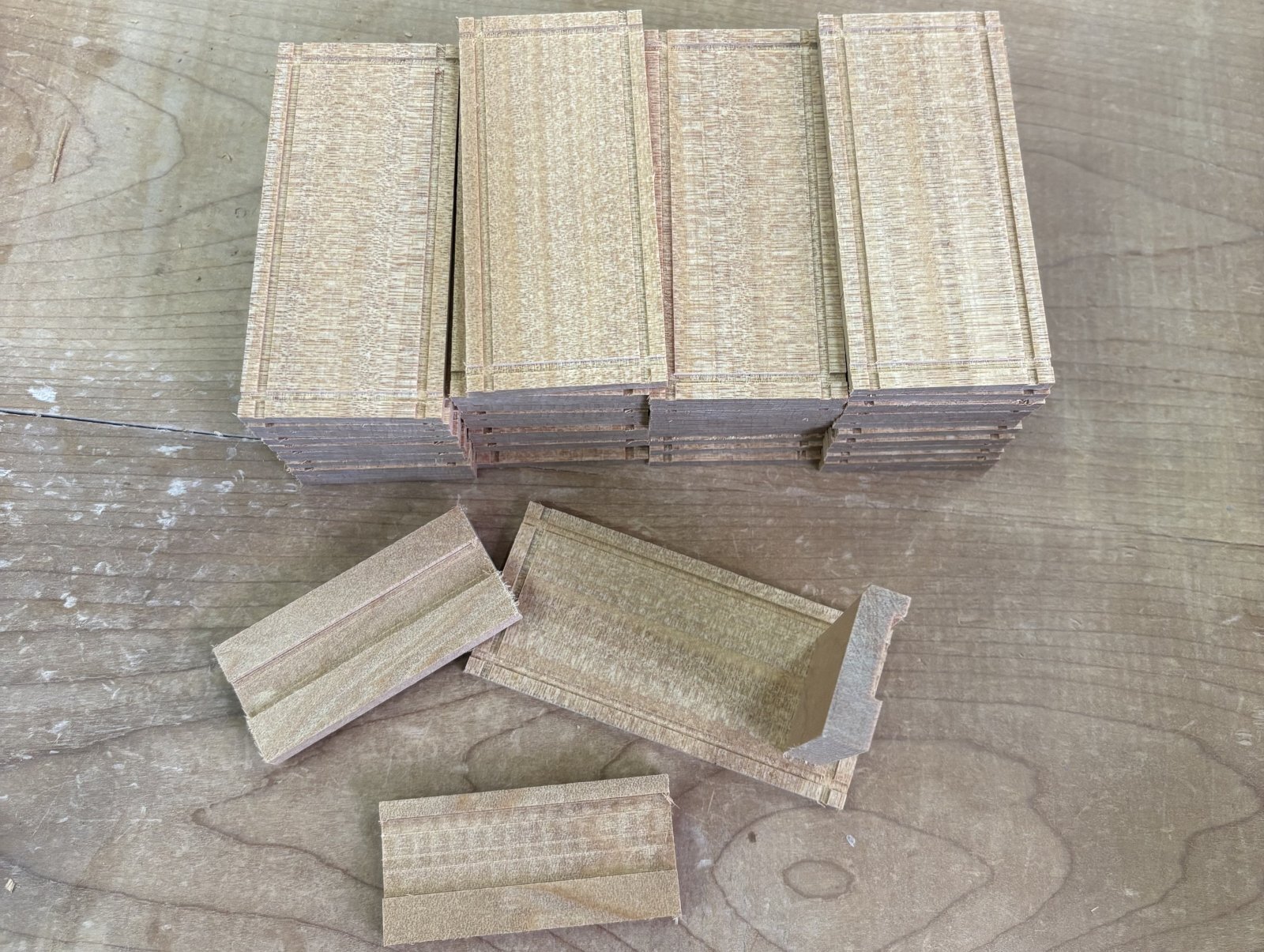
The photo shows the parts for the frame panels that I made for this box. For this project, I had a reason for making the inner box first. This is a little different from the method I have been using recently. It may not be very obvious from the photo, but the dimensions of this box are slightly different from the designs I usually make. If I had to compare it to one of my standard sizes, it is closest to a 4-sun puzzle box. However, because it is being made to match the yosegi sheets, it is a little shorter in length and a little wider than a standard 4-sun box. The height of the box is also a little different. Since the side panels will use the same checkered yosegi that I normally use, the height is somewhat limited by that. Even so, I intentionally made the box as tall as I reasonably could.
There are actually a couple of reasons why I normally avoid making puzzle boxes outside my standard specifications, but this time I decided to ignore them and simply make the box the way I want to...haha. I also plan to make a small change to the mechanism. It will still use the familiar sliding movements of a Japanese puzzle box, but I would like to make the sequence a little different from the typical pattern. My goal is to make it just a little more confusing to solve. These days, Japanese puzzle boxes are often judged mainly by the number of moves required to open them. In other words, a 27-step puzzle box is usually considered more valuable than a 14-step puzzle box. However, a non-standard 14-step mechanism can sometimes be more difficult to solve than a typical 27-step one. Once someone is familiar with the usual 27-step mechanisms, the movements can become somewhat predictable because they often follow a repeated pattern. In the photo, I cut a narrow groove in the axis panel. It is used to install a pin that will hold one of the parts in place. I hope the finished mechanism will have a slightly different feel from my usual designs.
As I mentioned a little while ago, yosegi likes humidity. Because of that, a day like this can be a good time to work with yosegi. I had planned to glue the yosegi sheets onto the panels today, and the timing worked out well. Then again, with the rainy season now underway, we will probably have many days like this for a while...haha. I decided to do the gluing in the afternoon, so during the morning I spent some time preparing the new puzzle box that I mentioned yesterday. This is a project that I started somewhat spontaneously, but I had actually been thinking about the mechanism for several days. At the same time, I had also been considering how to use the yosegi sheets that will be used for this project. Another reason is that I wanted to use the sheets before they became too dry from being stored for a long time. Normally, yosegi sheets have a thin wooden border around all four sides. This helps keep the pattern together and prevents the individual pieces from coming apart. The sheets I am using this time are leftovers from a previous project, so they were cut at the sheet stage. As a result, one side no longer has that border. Because of this, the pattern along that edge has become a little loose, so I would prefer to use the sheets sooner rather than later.
The photo shows the parts for the frame panels that I made for this box. For this project, I had a reason for making the inner box first. This is a little different from the method I have been using recently. It may not be very obvious from the photo, but the dimensions of this box are slightly different from the designs I usually make. If I had to compare it to one of my standard sizes, it is closest to a 4-sun puzzle box. However, because it is being made to match the yosegi sheets, it is a little shorter in length and a little wider than a standard 4-sun box. The height of the box is also a little different. Since the side panels will use the same checkered yosegi that I normally use, the height is somewhat limited by that. Even so, I intentionally made the box as tall as I reasonably could.
There are actually a couple of reasons why I normally avoid making puzzle boxes outside my standard specifications, but this time I decided to ignore them and simply make the box the way I want to...haha. I also plan to make a small change to the mechanism. It will still use the familiar sliding movements of a Japanese puzzle box, but I would like to make the sequence a little different from the typical pattern. My goal is to make it just a little more confusing to solve. These days, Japanese puzzle boxes are often judged mainly by the number of moves required to open them. In other words, a 27-step puzzle box is usually considered more valuable than a 14-step puzzle box. However, a non-standard 14-step mechanism can sometimes be more difficult to solve than a typical 27-step one. Once someone is familiar with the usual 27-step mechanisms, the movements can become somewhat predictable because they often follow a repeated pattern. In the photo, I cut a narrow groove in the axis panel. It is used to install a pin that will hold one of the parts in place. I hope the finished mechanism will have a slightly different feel from my usual designs.