Aruki Panels for the Double Box
I worked in the workshop all day today. It was cloudy, but the temperature was still quite high. In the morning, I started with the finishing work on the 3-sun boxes. Since there are two types with different side panels, the finishing methods are different, so I worked on them separately. In the afternoon, I applied the base coat as planned, and that was a relief. The weather is expected to get worse from tomorrow, so today was actually a good day to do the finishing work (Just the right humidity).
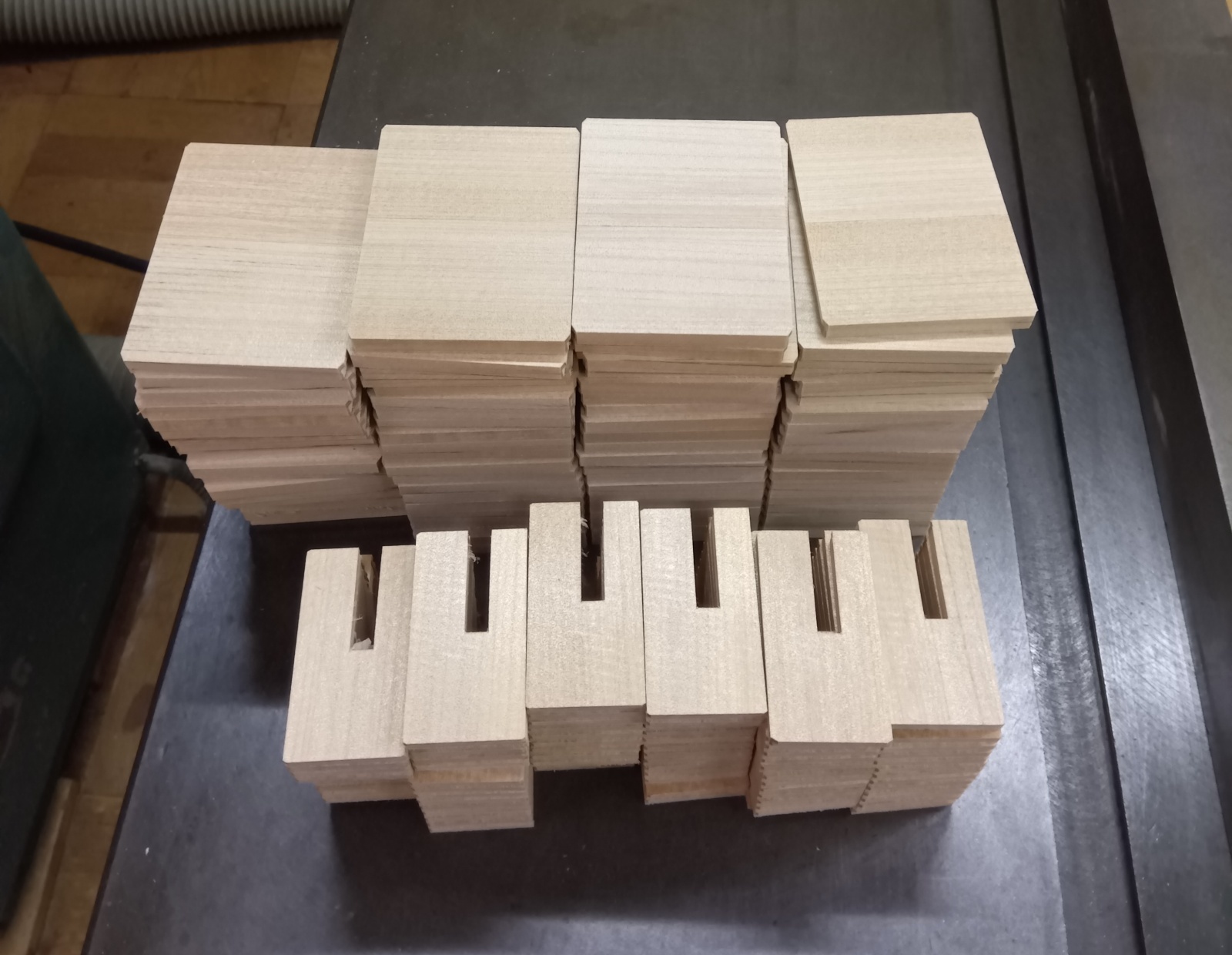
After that, I worked on making the Aruki sliding panels for the 4-sun double boxes (photo). Since two sides open, each box needs four Aruki panels, but there are only two types. There are two identical panels for the top and bottom, and two identical panels for the sides. If I compare it to another box, these are the same type of Aruki panels used in a 7-steps puzzle box. If possible, I would like to attach them tomorrow, but I will decide after checking the weather and humidity. Part of this lot will be traditional yosegi, but most of them will feature a combination of rosewood and walnut on the top and bottom. I’m also thinking of adding a few special pieces again this time. Solid wood panels may be difficult, but I might include some random grain types again. Since I made double boxes for the first time in a while, I’d like to add them. I don’t often have the chance to make this type unless I receive a request.
I haven’t mentioned this yet, but my next project is already decided. I’m planning to make a hexagonal 6-steps puzzle box again, which I haven’t made in a while. It will have traditional yosegi, and the side panels will be in an Ichimatsu pattern. Speaking of hexagonal boxes, I clearly remember trying to make a solid wood version last year and stopping partway through. It seems that using solid wood for the side panels is a bit difficult for this type of box. When I made the solid wood version before (about 10 years ago), I made it in a smaller size than this standard model. So this time, I will make it in the usual way, using panels with Ichimatsu yosegi sheets attached.
After that, I worked on making the Aruki sliding panels for the 4-sun double boxes (photo). Since two sides open, each box needs four Aruki panels, but there are only two types. There are two identical panels for the top and bottom, and two identical panels for the sides. If I compare it to another box, these are the same type of Aruki panels used in a 7-steps puzzle box. If possible, I would like to attach them tomorrow, but I will decide after checking the weather and humidity. Part of this lot will be traditional yosegi, but most of them will feature a combination of rosewood and walnut on the top and bottom. I’m also thinking of adding a few special pieces again this time. Solid wood panels may be difficult, but I might include some random grain types again. Since I made double boxes for the first time in a while, I’d like to add them. I don’t often have the chance to make this type unless I receive a request.
I haven’t mentioned this yet, but my next project is already decided. I’m planning to make a hexagonal 6-steps puzzle box again, which I haven’t made in a while. It will have traditional yosegi, and the side panels will be in an Ichimatsu pattern. Speaking of hexagonal boxes, I clearly remember trying to make a solid wood version last year and stopping partway through. It seems that using solid wood for the side panels is a bit difficult for this type of box. When I made the solid wood version before (about 10 years ago), I made it in a smaller size than this standard model. So this time, I will make it in the usual way, using panels with Ichimatsu yosegi sheets attached.