Symmetrical Box
The rain stopped, and it was sunny from the morning today. The roads and buildings that were wet from the rain had completely dried by around noon. I started the day working on the 3-sun boxes, and in the afternoon, I did the final coating on the 4-sun boxes that I had base-coated yesterday. I think they will be ready to add to my stock list soon. The next main work is the 3-sun 18-steps puzzle boxes, and at the same time, I have also started preparing for the next project, which is the 4-sun double Japanese puzzle boxes.
The yosegi sheets have already been applied. Some are traditional yosegi and Ichimatsu patterns, and the rest are planned to be natural wood designs. For now, as I mentioned before, I am planning to use a combination of rosewood and walnut. However, I haven’t fully decided if all of the remaining boxes will use this combination. I may add some limited designs as well. Today, I started with the preparation of the side panels. I prepared both the inner and outer side panels and fixed them with clamps.
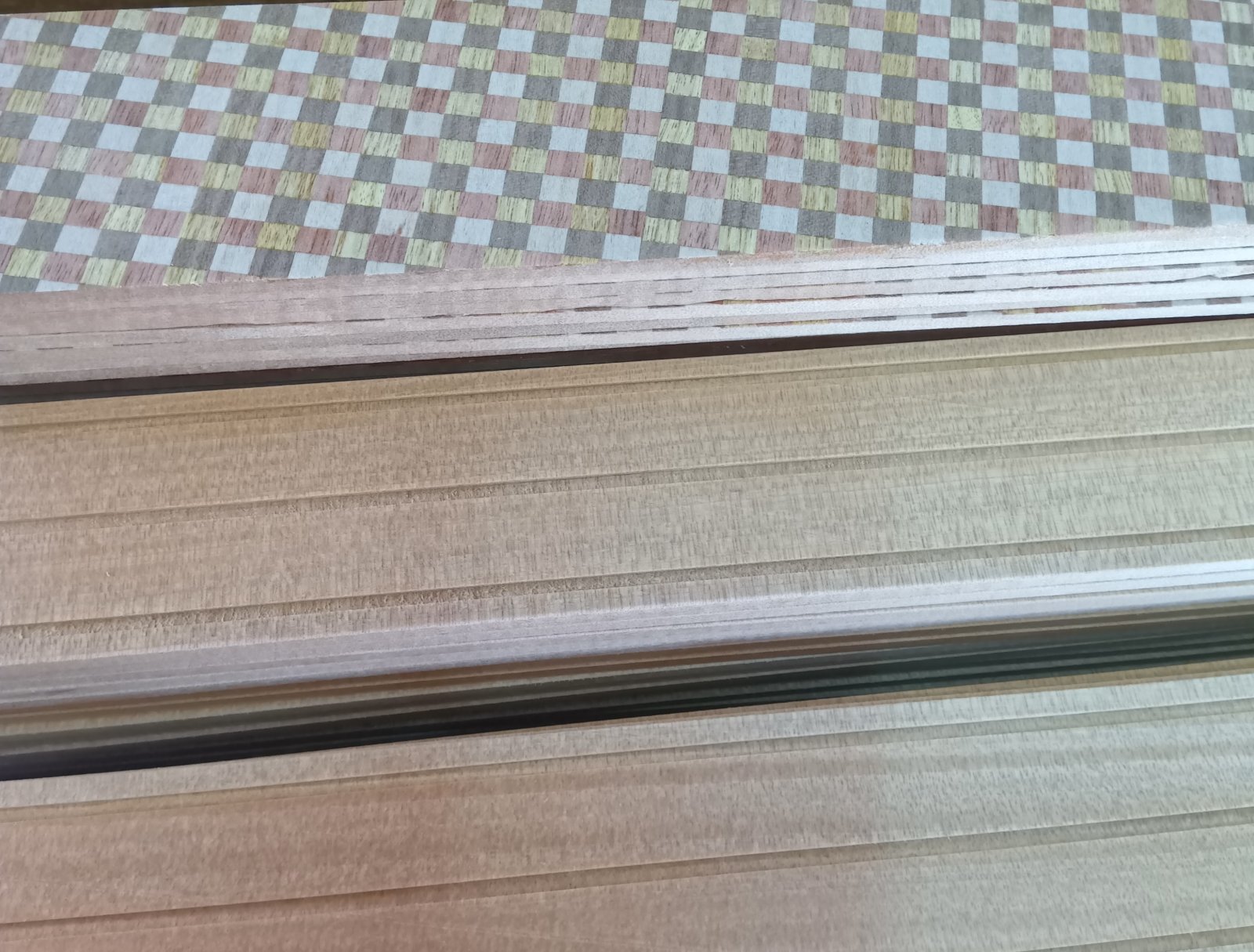
This time, the design will have two 7-step mechanisms. So, both sides have the same mechanism. The total number of steps is higher than a 7-step and 5-step combination, but the difficulty is lower. You can open it from either side, using either mechanism. Since it has two exactly the same mechanisms, this box is quite rare among puzzle boxes in that it has a symmetrical design. The photo shows the symmetrical panels for this box. They are still in a long board form, but a groove has already been made in the center to divide the upper and lower spaces. The top and bottom, the left and right Aruki panels, the internal parts, and even the inner side panels are all exactly the same. In most puzzle boxes, the left and right Aruki panels may differ slightly in length, or the internal parts may be different. But in this case, everything is completely identical. You could say it is like two 7-step puzzle boxes joined together. So, you could say there are almost no chances for careless mistakes during the making 🤣 Sometimes I accidentally mix up the left and right Aruki panels and attach them the wrong way, but with this box, they can be used on either side. It’s a box that you can make without much confusion.
The yosegi sheets have already been applied. Some are traditional yosegi and Ichimatsu patterns, and the rest are planned to be natural wood designs. For now, as I mentioned before, I am planning to use a combination of rosewood and walnut. However, I haven’t fully decided if all of the remaining boxes will use this combination. I may add some limited designs as well. Today, I started with the preparation of the side panels. I prepared both the inner and outer side panels and fixed them with clamps.
This time, the design will have two 7-step mechanisms. So, both sides have the same mechanism. The total number of steps is higher than a 7-step and 5-step combination, but the difficulty is lower. You can open it from either side, using either mechanism. Since it has two exactly the same mechanisms, this box is quite rare among puzzle boxes in that it has a symmetrical design. The photo shows the symmetrical panels for this box. They are still in a long board form, but a groove has already been made in the center to divide the upper and lower spaces. The top and bottom, the left and right Aruki panels, the internal parts, and even the inner side panels are all exactly the same. In most puzzle boxes, the left and right Aruki panels may differ slightly in length, or the internal parts may be different. But in this case, everything is completely identical. You could say it is like two 7-step puzzle boxes joined together. So, you could say there are almost no chances for careless mistakes during the making 🤣 Sometimes I accidentally mix up the left and right Aruki panels and attach them the wrong way, but with this box, they can be used on either side. It’s a box that you can make without much confusion.