Why quick assembly matters
It rained all day today. Even so, I was able to make progress on several tasks. Because of the high humidity, I cannot work on the mechanisms such as the Aruki panels, but today I did not have that kind of work scheduled. The 14-steps Mame 1-sun puzzle boxes have now been finished, including the final coating. I would like to wait for a day with better weather to check the mechanisms. Until then, I will keep them in a humidity-controlled case. In addition, work on the 4-sun 14-steps puzzle boxes has now fully started. Today, I prepared all the materials, made the frame panels, and assembled them.
The frame panels, especially the long side panels, can still warp after being made, so it is better to stack them and hold them with clamps. Another option is to assemble them as soon as possible. For the assembly, I fix the parts with rubber bands while the glue dries. After that, I sometimes stack the assembled frame boxes and hold them again with clamps to keep them stable. If these long side panels warp, it can create gaps between the panel and the lid, so I need to be careful even during the production process. Because of their length, they are more likely to warp. That was as far as I could go today. I thought about putting the pieces in a case to protect them from humidity, but instead I decided to leave them clamped like this before finishing for the day.
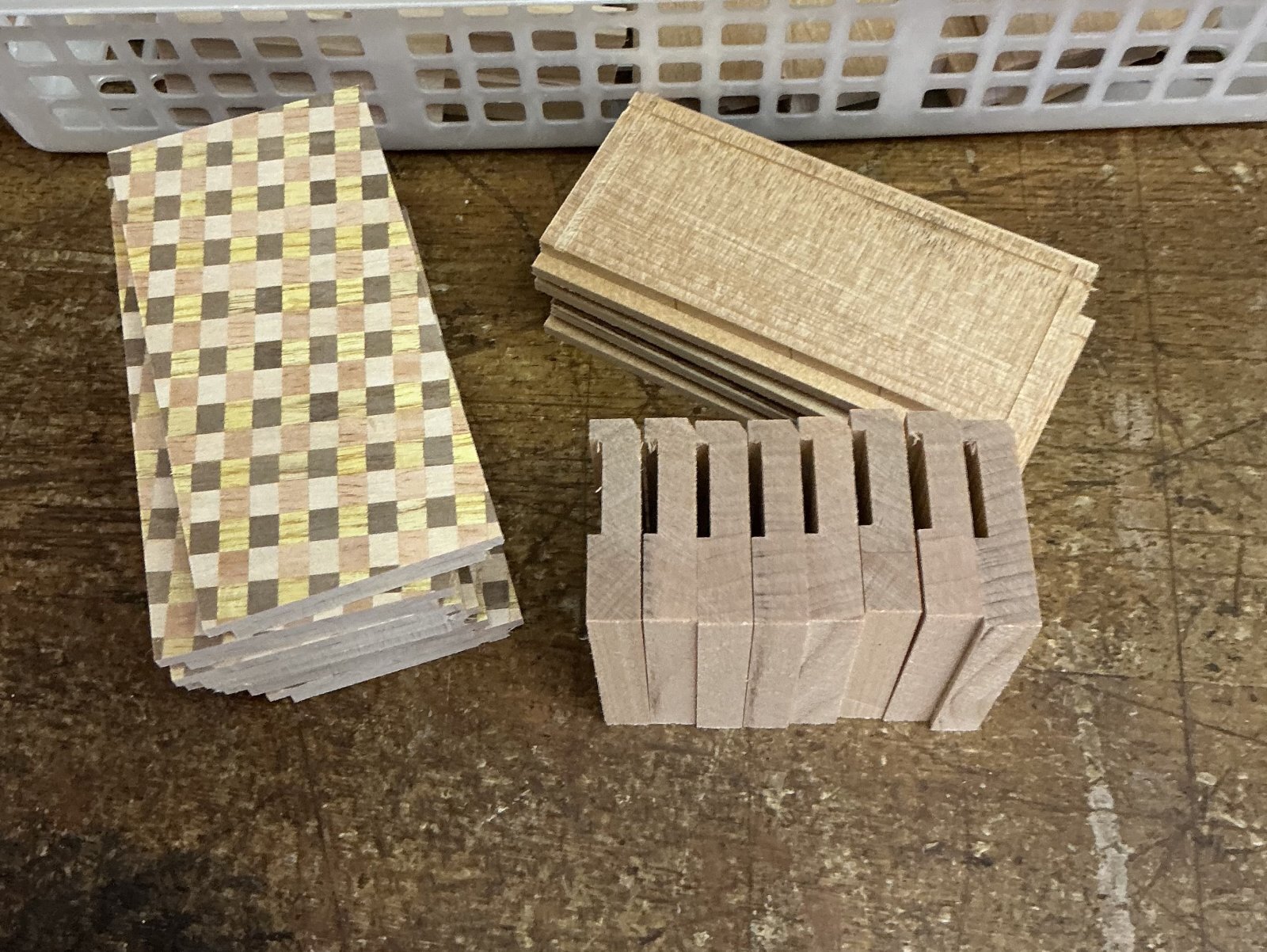
The photo shows the frame assembly in progress. I apply glue to these eight axis panels in the photo and attach them to the long side panels. Since this is a 14-steps puzzle box, I do not need as much glue as I would for boxes with 18 steps or more. However, it is still important not to use too little. I apply a sufficient amount of glue, while keeping the excess to a minimum. Those who are familiar with wood may notice that the area where I apply glue on these axis panels (the part facing upward in the photo, the side of the axis panel) is what is called the end grain. I apply glue to this end grain area. Since the glue is water-based, the end grain quickly absorbs it. This is because the wood has small channels that carry moisture inside, and the glue is drawn into them. Because of this, if I use too little glue or take too much time before assembly, the joint may not bond properly. So it is important to work quickly. At the same time, I need to apply enough glue so that it still holds even after some absorption. In the photo, you can see eight panels. Each box needs two, so this is for four boxes. After gluing, I fix them with rubber bands, so this time I secure four boxes together. The number can be adjusted depending on how many boxes I group together, but if there are too many, it becomes unstable. I apply glue to the eight panels, assemble them one by one, and after finishing four boxes, I fix them together. Because of this, there should be no difference between the first and the fourth box, so I need to work quickly. If I go too slowly, the glue will be absorbed into the end grain (and it happens quite fast). That is why working with about four boxes at a time is just right.
The frame panels, especially the long side panels, can still warp after being made, so it is better to stack them and hold them with clamps. Another option is to assemble them as soon as possible. For the assembly, I fix the parts with rubber bands while the glue dries. After that, I sometimes stack the assembled frame boxes and hold them again with clamps to keep them stable. If these long side panels warp, it can create gaps between the panel and the lid, so I need to be careful even during the production process. Because of their length, they are more likely to warp. That was as far as I could go today. I thought about putting the pieces in a case to protect them from humidity, but instead I decided to leave them clamped like this before finishing for the day.
The photo shows the frame assembly in progress. I apply glue to these eight axis panels in the photo and attach them to the long side panels. Since this is a 14-steps puzzle box, I do not need as much glue as I would for boxes with 18 steps or more. However, it is still important not to use too little. I apply a sufficient amount of glue, while keeping the excess to a minimum. Those who are familiar with wood may notice that the area where I apply glue on these axis panels (the part facing upward in the photo, the side of the axis panel) is what is called the end grain. I apply glue to this end grain area. Since the glue is water-based, the end grain quickly absorbs it. This is because the wood has small channels that carry moisture inside, and the glue is drawn into them. Because of this, if I use too little glue or take too much time before assembly, the joint may not bond properly. So it is important to work quickly. At the same time, I need to apply enough glue so that it still holds even after some absorption. In the photo, you can see eight panels. Each box needs two, so this is for four boxes. After gluing, I fix them with rubber bands, so this time I secure four boxes together. The number can be adjusted depending on how many boxes I group together, but if there are too many, it becomes unstable. I apply glue to the eight panels, assemble them one by one, and after finishing four boxes, I fix them together. Because of this, there should be no difference between the first and the fourth box, so I need to work quickly. If I go too slowly, the glue will be absorbed into the end grain (and it happens quite fast). That is why working with about four boxes at a time is just right.