Specifications of the inner box
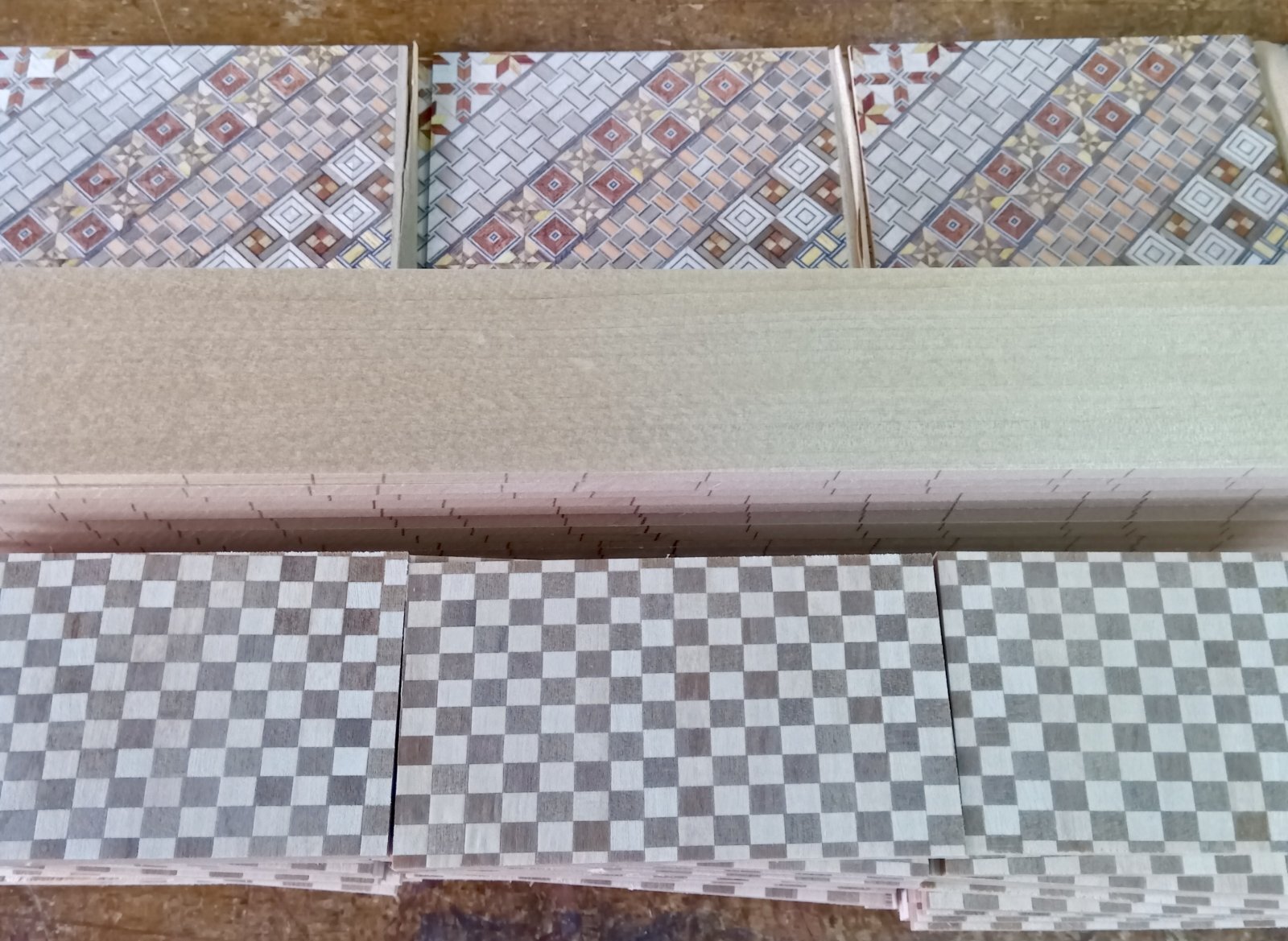
This morning was cold again, but during the day it was calm and sunny with no wind. I stayed at my workshop all day and worked. Starting today, I began gluing the sliding key panels for the 5-sun puzzle boxes. I finished the preparation in the morning, and in the afternoon I glued one side of the panel. Because the air is very dry, the gluing work went smoothly without any problems. I will glue the other side tomorrow.
As the assembly work for the 5-sun puzzle boxes is now close to completion, I have started the next project. This is the inner box for the nested set, a 7-steps puzzle box. For now, this is still a preparation stage. I am gluing the inner structural side panels onto the ichimatsu yosegi boards that have already been prepared for the side panels (photo).
So, at this stage, the specifications for the inner box are now fully decided. The size will be made to fit the inside of the 5-sun box, so I cannot really describe it as a fixed “sun” size. If I had to say, it is probably a little smaller than a 4-sun box. I carefully measured the inner dimensions of the 5-sun box, and I spent some time deciding the exact size. How I plan to sell it is also an important point. For now, I am thinking that this time I will not prepare a separate presentation box for the inner 7-step box. Instead, I will put it in my usual vinyl bag and place it inside the 5-sun box. Because the bag makes the size slightly larger, I included that in my calculations. In the end, I plan to make the inner box about 4 to 5 mm smaller than the available inner space. To summarize the design, the inner box will be a 7-step mechanism. The top panel will use traditional yosegi, the bottom panel will be a panel with makore wood applied, and the side panels will be two-color ichimatsu yosegi.
The makore wood sheet used for the bottom panel is a natural wood sheet that I have used about three times since the end of last year. It is from a different manufacturer than the one I used for many years before. I am really surprised by how many different types of wood sheets there are. Basically, these sheets are made by slicing natural wood very thin and then bonding it onto an even thinner paper-like backing. However, the way they are made differs greatly depending on the manufacturer. Because of these differences, even the type of glue needed to attach the sheet can change. The one I am using this time bonds well with regular glue, and I like it very much. It is a bit disappointing that large sizes are not produced, but the smaller sizes are easy to order and arrive by mail, which is very convenient.
As the assembly work for the 5-sun puzzle boxes is now close to completion, I have started the next project. This is the inner box for the nested set, a 7-steps puzzle box. For now, this is still a preparation stage. I am gluing the inner structural side panels onto the ichimatsu yosegi boards that have already been prepared for the side panels (photo).
So, at this stage, the specifications for the inner box are now fully decided. The size will be made to fit the inside of the 5-sun box, so I cannot really describe it as a fixed “sun” size. If I had to say, it is probably a little smaller than a 4-sun box. I carefully measured the inner dimensions of the 5-sun box, and I spent some time deciding the exact size. How I plan to sell it is also an important point. For now, I am thinking that this time I will not prepare a separate presentation box for the inner 7-step box. Instead, I will put it in my usual vinyl bag and place it inside the 5-sun box. Because the bag makes the size slightly larger, I included that in my calculations. In the end, I plan to make the inner box about 4 to 5 mm smaller than the available inner space. To summarize the design, the inner box will be a 7-step mechanism. The top panel will use traditional yosegi, the bottom panel will be a panel with makore wood applied, and the side panels will be two-color ichimatsu yosegi.
The makore wood sheet used for the bottom panel is a natural wood sheet that I have used about three times since the end of last year. It is from a different manufacturer than the one I used for many years before. I am really surprised by how many different types of wood sheets there are. Basically, these sheets are made by slicing natural wood very thin and then bonding it onto an even thinner paper-like backing. However, the way they are made differs greatly depending on the manufacturer. Because of these differences, even the type of glue needed to attach the sheet can change. The one I am using this time bonds well with regular glue, and I like it very much. It is a bit disappointing that large sizes are not produced, but the smaller sizes are easy to order and arrive by mail, which is very convenient.