The right material in the right place
Today was a relatively warm day. However, extremely strong winds blew in many areas. It is evening now, but the wind is still strong. Of course, heavy rain is unpleasant, but I personally feel that wind is the most frightening. It can cause severe damage to buildings and other structures. Today, this topic has been widely covered in the news.I wonder if the increase in strong winds like this is also an effect of climate change…
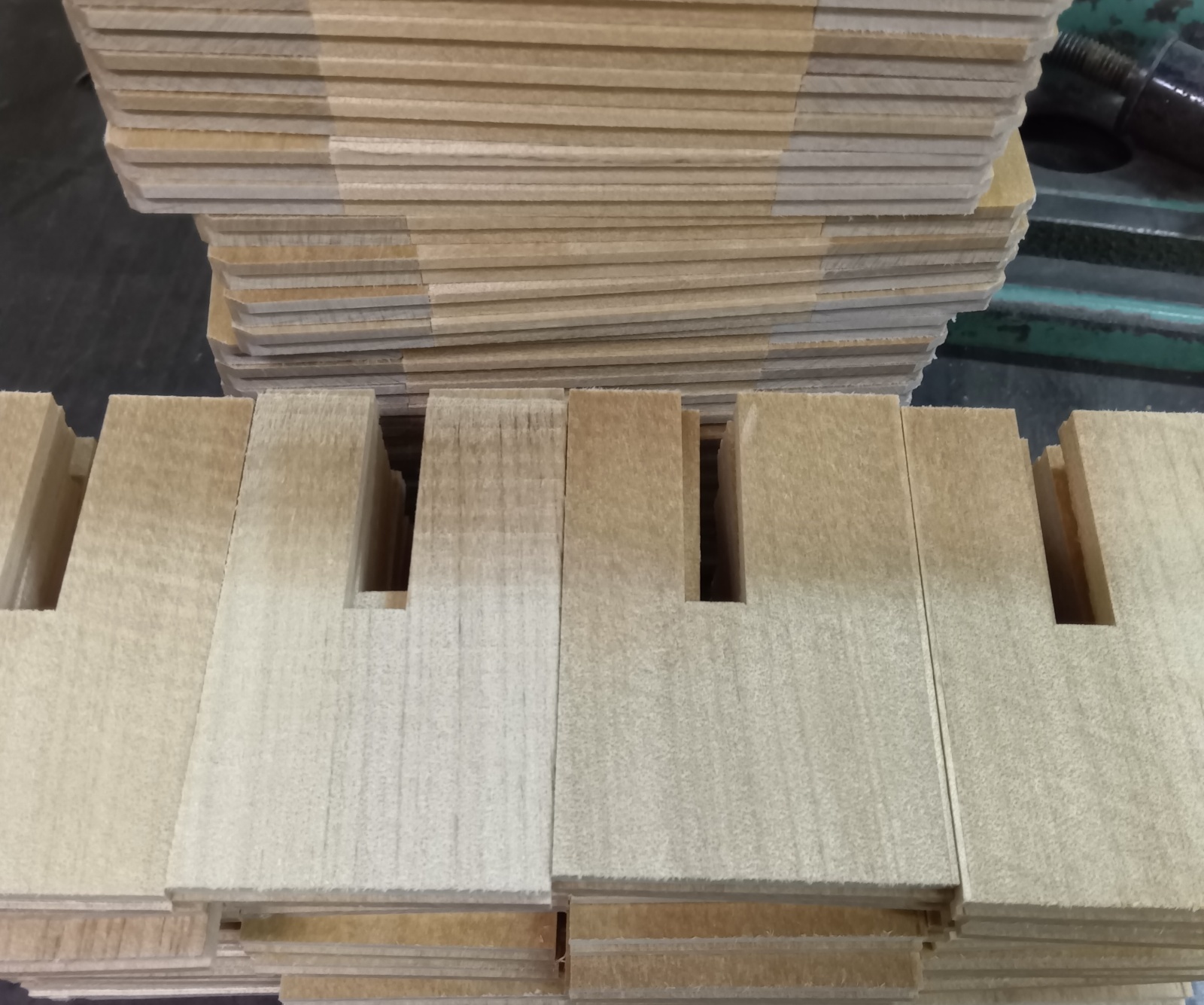
Even in these unsettled conditions, today felt a bit restless, but I worked on making the Aruki moving panels for the 5-sun 14-steps Japanese puzzle boxes that I am currently producing. The air is very dry, which makes it a good time for this kind of work. The photo shows the three different types of Aruki panels used for this box. The way the Aruki parts are made is very delicate, so I am always careful when choosing the wood. It is hard to see in the photo, but for the Aruki used in the front sliding panel, I try to use a softer part of the wood. All of the boxes are made from agathis wood, but the quality of agathis varies depending on the part of the tree. Some areas are hard, and others are soft. From these, I carefully choose the softer sections to use.
This wood is imported from Southeast Asia, and there are two types. One type is imported as whole logs after the trees are cut down. The other type is cut locally into boards to a thickness of 3 to 4 centimeters before being exported. These days, only the board type is available. It is said that by doing this processing locally, jobs are created there and the price can be set higher. Most of these boards are dried artificially. They are placed in large drying machines, where the moisture is forced out. Wood that is dried this way is said to become harder than wood that is cut from logs and dried naturally in the sun. I can actually feel this difference when I work with it. Because of this, finding softer areas of the wood to use for Aruki panels, like in this project, has become more difficult than before. Still, I carefully look for the softest possible parts and use them for the Aruki panels as much as I can.
Even in these unsettled conditions, today felt a bit restless, but I worked on making the Aruki moving panels for the 5-sun 14-steps Japanese puzzle boxes that I am currently producing. The air is very dry, which makes it a good time for this kind of work. The photo shows the three different types of Aruki panels used for this box. The way the Aruki parts are made is very delicate, so I am always careful when choosing the wood. It is hard to see in the photo, but for the Aruki used in the front sliding panel, I try to use a softer part of the wood. All of the boxes are made from agathis wood, but the quality of agathis varies depending on the part of the tree. Some areas are hard, and others are soft. From these, I carefully choose the softer sections to use.
This wood is imported from Southeast Asia, and there are two types. One type is imported as whole logs after the trees are cut down. The other type is cut locally into boards to a thickness of 3 to 4 centimeters before being exported. These days, only the board type is available. It is said that by doing this processing locally, jobs are created there and the price can be set higher. Most of these boards are dried artificially. They are placed in large drying machines, where the moisture is forced out. Wood that is dried this way is said to become harder than wood that is cut from logs and dried naturally in the sun. I can actually feel this difference when I work with it. Because of this, finding softer areas of the wood to use for Aruki panels, like in this project, has become more difficult than before. Still, I carefully look for the softest possible parts and use them for the Aruki panels as much as I can.