The Saw blade thickness and the Pattern shift
Today is the start of a new week, and also the beginning of December. This morning it was very cold, but during the day the temperature went up so much that it felt almost hot (about 21°C). Because of this big change in temperature, many people seem to be catching colds. Influenza is also spreading now, and the news is warning everyone to be careful.
This morning, I prepared the materials for the other parts of the 6-sun 18-steps puzzle box and worked on making the frame. I will start assembling the box from tomorrow.
As I wrote a few days ago, the yosegi sheets for the side panels came out a little smaller than usual this time, so I lowered the height of the box a little to match them — about 4 mm. When calculating the size of the side panels, there is one thing that I always have to think about: the size of the sliding key panel. The sliding key panel is made by cutting one board into three pieces, so I must include the thickness of the saw blade in my calculations. The wood becomes smaller by the amount of the blade thickness. And if the size becomes smaller, the yosegi pattern will also be cut off by that amount. For this reason, it is better to use the thinnest blade possible so that the pattern does not disappear too much. I have tried many different options, and now I use a 1.3 mm blade. Of course, this cutting is done with a machine, not by hand like in the old days. It is a woodworking machine with a round saw blade. The blade thickness is 1.3 mm. I used to use a 1 mm blade because I thought thinner was better, but the blade bent while cutting. At 1 mm, it is too thin, and it starts to wobble during the cut. When that happens, the sliding keys cannot be cut straight. For stable cutting, the 1.3 mm round blade seems to work best at the moment. So now, since the round saw blade is about total 2.6 mm thick, I prepare the sliding-key section of the side panels about 3 mm wider when I make them.
This issue of the saw blade thickness and the pattern shifting may be an eternal problem for Japanese puzzle boxes 😅 Whenever traditional yosegi is used on the side panels, this pattern shift always happens. Of course, there is a method where a straight piece of different wood is placed exactly where the saw will pass, so the blade cuts through that part only, and the yosegi pattern does not look misaligned. This method has been used many times in the past. However, to do this, you must design a special yosegi pattern just for that purpose, and it cannot be done with the popular traditional diagonal yosegi that many people like. The only type that does not have this problem is the solid-wood side panel style that I often make. With this type, the sliding key position is harder to see, which many people like. I think I will continue searching for better solutions in the future.
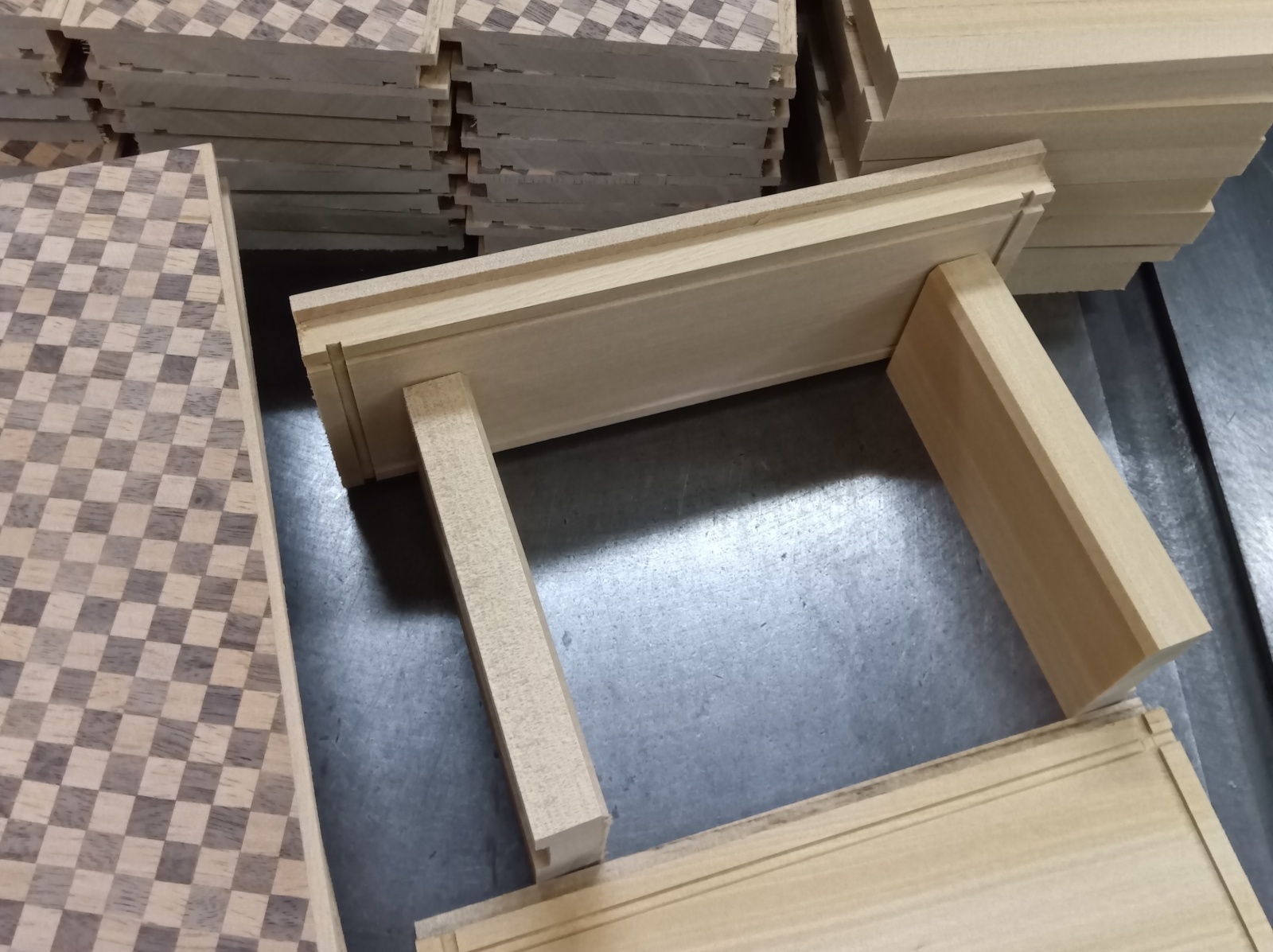
The photo shows the parts for the frame. Since this box is 6 sun, I made it stronger by using 8 mm thick panels for the inner side panels, and 14 mm thick panels for the shaft panels.
This morning, I prepared the materials for the other parts of the 6-sun 18-steps puzzle box and worked on making the frame. I will start assembling the box from tomorrow.
As I wrote a few days ago, the yosegi sheets for the side panels came out a little smaller than usual this time, so I lowered the height of the box a little to match them — about 4 mm. When calculating the size of the side panels, there is one thing that I always have to think about: the size of the sliding key panel. The sliding key panel is made by cutting one board into three pieces, so I must include the thickness of the saw blade in my calculations. The wood becomes smaller by the amount of the blade thickness. And if the size becomes smaller, the yosegi pattern will also be cut off by that amount. For this reason, it is better to use the thinnest blade possible so that the pattern does not disappear too much. I have tried many different options, and now I use a 1.3 mm blade. Of course, this cutting is done with a machine, not by hand like in the old days. It is a woodworking machine with a round saw blade. The blade thickness is 1.3 mm. I used to use a 1 mm blade because I thought thinner was better, but the blade bent while cutting. At 1 mm, it is too thin, and it starts to wobble during the cut. When that happens, the sliding keys cannot be cut straight. For stable cutting, the 1.3 mm round blade seems to work best at the moment. So now, since the round saw blade is about total 2.6 mm thick, I prepare the sliding-key section of the side panels about 3 mm wider when I make them.
This issue of the saw blade thickness and the pattern shifting may be an eternal problem for Japanese puzzle boxes 😅 Whenever traditional yosegi is used on the side panels, this pattern shift always happens. Of course, there is a method where a straight piece of different wood is placed exactly where the saw will pass, so the blade cuts through that part only, and the yosegi pattern does not look misaligned. This method has been used many times in the past. However, to do this, you must design a special yosegi pattern just for that purpose, and it cannot be done with the popular traditional diagonal yosegi that many people like. The only type that does not have this problem is the solid-wood side panel style that I often make. With this type, the sliding key position is harder to see, which many people like. I think I will continue searching for better solutions in the future.
The photo shows the parts for the frame. Since this box is 6 sun, I made it stronger by using 8 mm thick panels for the inner side panels, and 14 mm thick panels for the shaft panels.