Unique Wood
Today is the day when the typhoon is passing closest to our area. As I write this, the rain and wind are expected to become even stronger. Some residential areas in other regions already seem to be flooded, which is worrying. For now, the road to my workshop appears to be open, but the road along the coast has been closed for several days. I am now considering whether it will be safe to go to the workshop later to check on things.
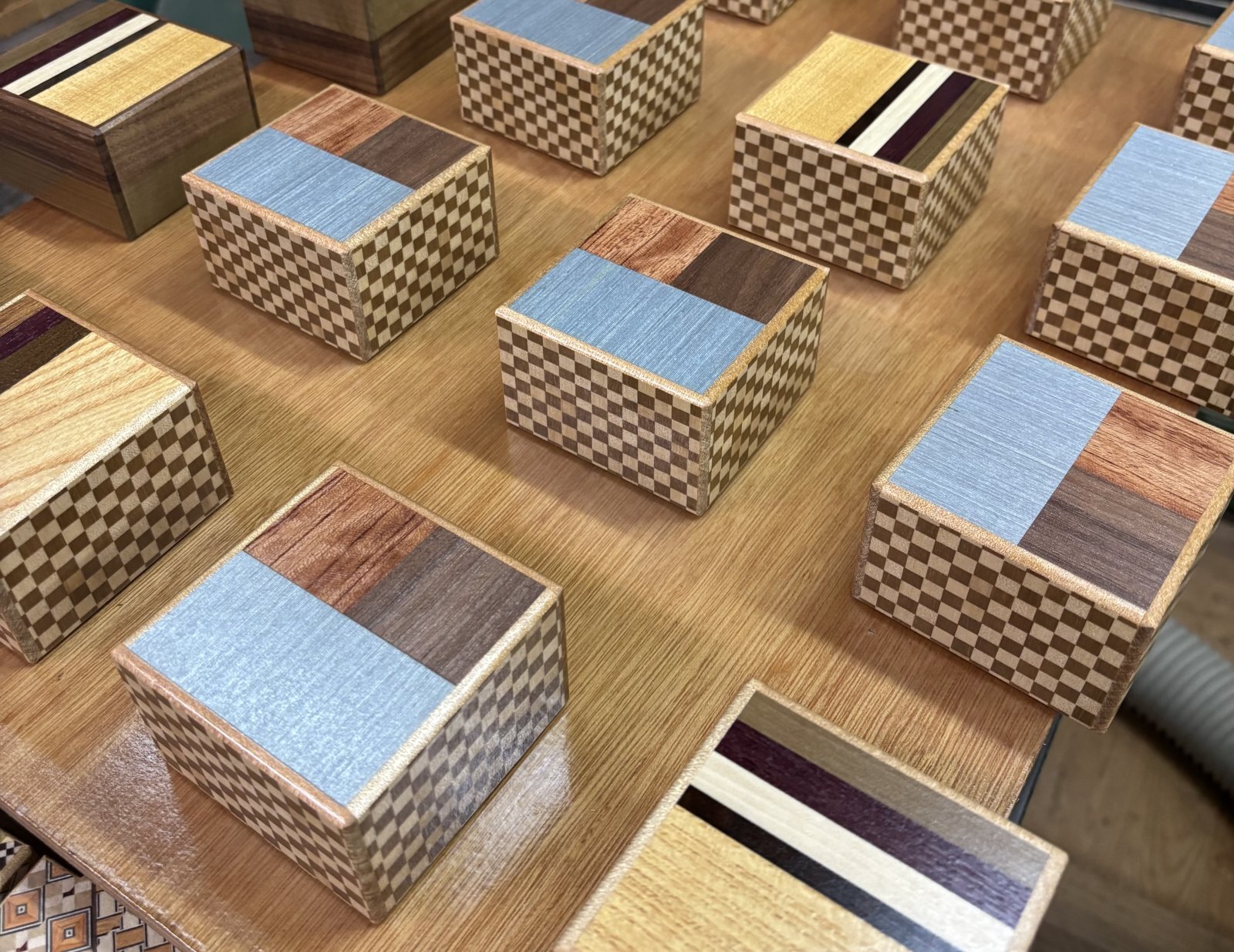
In the end, I will not be doing any work today, but I am glad that I expected this situation and completed the work yesterday. I have several orders that need to be shipped on September 24, after the holiday, so I plan to finish those first. I have also received several inquiries about the limited-edition boxes in this batch of Square puzzle boxes. Some people have already told me that they would like to buy one, which I greatly appreciate. Many people seem to be especially interested in the blue wood that I used for the first time. For this design, I combined the blue wood with Walnut and Bubinga to create a random wood grain pattern. I am making about 20 of them, so I do not think they will sell out immediately. Please do not worry.
This blue is not the natural color of the wood. The wood is poplar, and it has been colored blue. Colored wood like this is used for many things, including children’s toys. There are two main ways to color wood. One is to completely cover the wood with color so that it no longer looks like wood. The other, as with this blue wood, is to let the color soak into the wood rather than simply coating the surface, while still allowing the natural grain underneath to remain visible. If the grain is completely hidden, it is difficult to tell that the material is wood, and it can also look a little unnatural when combined with other woods. This blue poplar still has the natural look and feel of wood, so it matches nicely with the walnut and bubinga used in this design.
Colored wood like this has been used in this area for a long time. Blue and pink colored woods were especially popular in wood inlay. Some of you may already know this from my blog posts about old Japanese puzzle boxes. The blue wood used this time was actually colored with a method that is a little different from the traditional one, but it has been dyed very beautifully. However, because the base wood is a natural material, the color will not be exactly the same on every piece. Please understand that there may be some uneven areas or small differences in color. I think these differences also give the wood a nice natural character. The completion date has not yet been decided, but I plan to list these puzzle boxes on my website before the end of this month.
In the end, I will not be doing any work today, but I am glad that I expected this situation and completed the work yesterday. I have several orders that need to be shipped on September 24, after the holiday, so I plan to finish those first. I have also received several inquiries about the limited-edition boxes in this batch of Square puzzle boxes. Some people have already told me that they would like to buy one, which I greatly appreciate. Many people seem to be especially interested in the blue wood that I used for the first time. For this design, I combined the blue wood with Walnut and Bubinga to create a random wood grain pattern. I am making about 20 of them, so I do not think they will sell out immediately. Please do not worry.
This blue is not the natural color of the wood. The wood is poplar, and it has been colored blue. Colored wood like this is used for many things, including children’s toys. There are two main ways to color wood. One is to completely cover the wood with color so that it no longer looks like wood. The other, as with this blue wood, is to let the color soak into the wood rather than simply coating the surface, while still allowing the natural grain underneath to remain visible. If the grain is completely hidden, it is difficult to tell that the material is wood, and it can also look a little unnatural when combined with other woods. This blue poplar still has the natural look and feel of wood, so it matches nicely with the walnut and bubinga used in this design.
Colored wood like this has been used in this area for a long time. Blue and pink colored woods were especially popular in wood inlay. Some of you may already know this from my blog posts about old Japanese puzzle boxes. The blue wood used this time was actually colored with a method that is a little different from the traditional one, but it has been dyed very beautifully. However, because the base wood is a natural material, the color will not be exactly the same on every piece. Please understand that there may be some uneven areas or small differences in color. I think these differences also give the wood a nice natural character. The completion date has not yet been decided, but I plan to list these puzzle boxes on my website before the end of this month.