Preventing Warping During Finishing
Today was completely different, and it turned out to be a very cool day. The temperature was only around 23°C (73°F), which felt more like later in autumn. I’ve heard that quite a few people are catching colds because the weather keeps changing between hot and cool. Of course, the hot weather has been tough, but I was still surprised by how suddenly it became so cool.
The humidity is still high, so the kind of work I can do is limited. Today, I worked on finishing the 3-sun boxes. Yesterday evening, the humidity dropped quite a bit after we had some sunshine in the afternoon, so I quickly took the chance to attach the panels on the other side. The weather forecast said we would have bad weather for a while, so I didn’t want to miss the opportunity. For the finishing work, I actually feel more comfortable working when it isn’t too sunny. However, I worked quickly because I didn’t want the boxes to absorb too much moisture before applying the first coat.
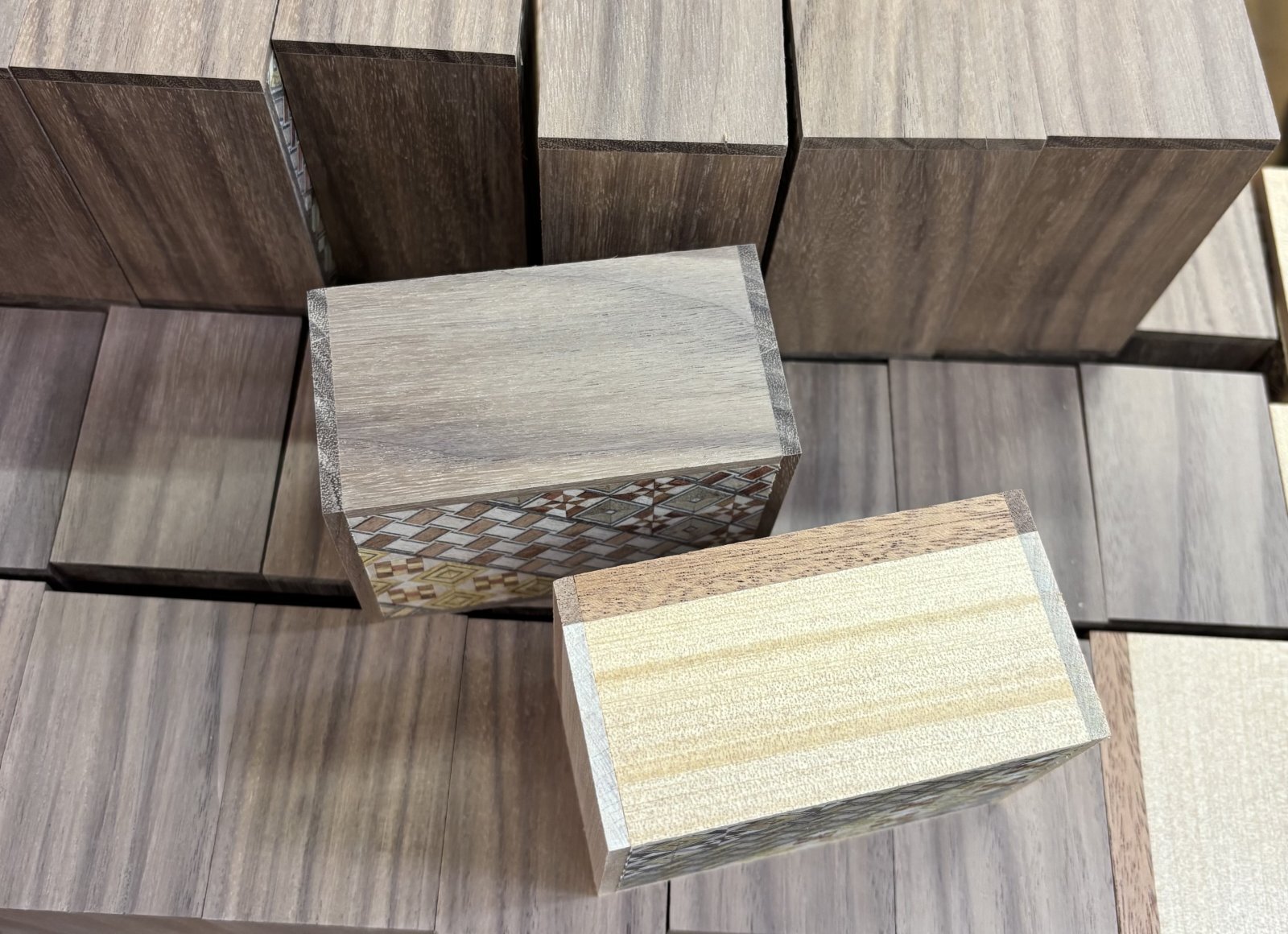
This time, all of the side panels are natural wood, so I need to sand the sides carefully. I use a machine for this, and one thing I’m very careful about is not creating too much heat from friction. Even though I use a machine, I hold each box against it by hand, so I can control how much pressure I use and how long I sand it. If I press too hard or sand for too long, the panels can become warm. When that happens, the heated side can dry out and the panel may warp toward the outside of the box. If a panel warps outward, it can create a gap between the box and the panel. So I’m careful to sand each side quickly, without keeping it against the machine for too long.
Since these boxes have natural wood side panels, I made the corners with a straight angled cut this time. Even at this stage, the edge of a panel can sometimes chip from the impact of the cutting tool, so it is very important to use a very sharp blade. If a small piece chips off, it can be quite difficult to repair because the area is so small. To prevent this, I try different things, such as not cutting away too much at once and choosing an angle that seems less likely to cause chipping. Some of this comes from experience and feel rather than exact measurements. After that, I sanded the top and bottom surfaces once more and moved on to applying the first coat. The weather is still not very good, so even though the boxes now have their first coat, I’ll keep them in a humidity-controlled case just to be safe.
The humidity is still high, so the kind of work I can do is limited. Today, I worked on finishing the 3-sun boxes. Yesterday evening, the humidity dropped quite a bit after we had some sunshine in the afternoon, so I quickly took the chance to attach the panels on the other side. The weather forecast said we would have bad weather for a while, so I didn’t want to miss the opportunity. For the finishing work, I actually feel more comfortable working when it isn’t too sunny. However, I worked quickly because I didn’t want the boxes to absorb too much moisture before applying the first coat.
This time, all of the side panels are natural wood, so I need to sand the sides carefully. I use a machine for this, and one thing I’m very careful about is not creating too much heat from friction. Even though I use a machine, I hold each box against it by hand, so I can control how much pressure I use and how long I sand it. If I press too hard or sand for too long, the panels can become warm. When that happens, the heated side can dry out and the panel may warp toward the outside of the box. If a panel warps outward, it can create a gap between the box and the panel. So I’m careful to sand each side quickly, without keeping it against the machine for too long.
Since these boxes have natural wood side panels, I made the corners with a straight angled cut this time. Even at this stage, the edge of a panel can sometimes chip from the impact of the cutting tool, so it is very important to use a very sharp blade. If a small piece chips off, it can be quite difficult to repair because the area is so small. To prevent this, I try different things, such as not cutting away too much at once and choosing an angle that seems less likely to cause chipping. Some of this comes from experience and feel rather than exact measurements. After that, I sanded the top and bottom surfaces once more and moved on to applying the first coat. The weather is still not very good, so even though the boxes now have their first coat, I’ll keep them in a humidity-controlled case just to be safe.