The Precision of the Fit
Today marks the start of a new week and also the beginning of June. It was another very hot day. We have had many unusually warm days recently, and today felt like summer as well, with temperatures rising above 30°C. On days like this, it can be difficult to do detailed work, but I still managed to make progress on several tasks today.
Today, I mainly worked on a 2.5-sun puzzle box. The frame had been completed by yesterday, so today I made the Aruki sliding panels to fit it.This box has three Aruki panels, including the top panel. There are many puzzle boxes that use three Aruki panels, and among them, mechanisms up to 14 steps fall into this category.In most of those boxes, sliding keys are attached to both the left and right Aruki panels. However, this box has a sliding key on only one side. The other side is also an Aruki panel, but like a 4-steps puzzle box, it does not have a separate sliding key and moves as a single panel. Among the Japanese puzzle boxes that I make, this 5-steps puzzle box is the only one with this type of three-Aruki-panel construction. It would be possible to create other boxes using the same structure. For example, a 7-steps puzzle box could be made with three Aruki panels, and even a slightly more unusual 9-steps puzzle box is possible. Although I do not make them at present, I have made such boxes in the past.
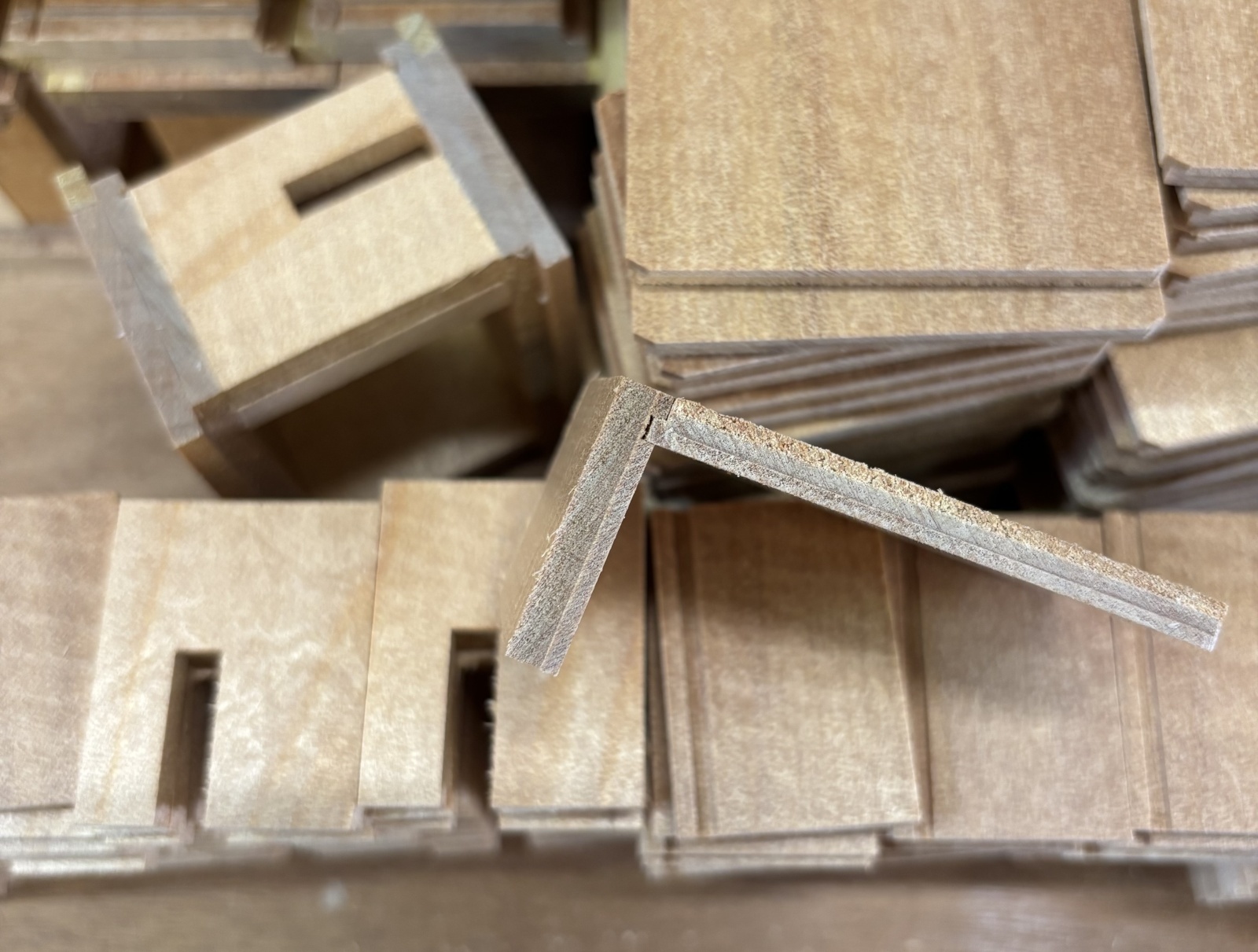
In a box with this type of construction, when the side with the sliding key panel must be moved first—which is also the case with this box—a mechanism is needed to prevent the Aruki panel on the other side from moving. That mechanism can be seen in the photo. A protrusion on the lid fits into a groove in the Aruki panel. As long as these two parts remain engaged, the Aruki panel cannot move.In the photo, it may look as though the two parts are simply engaged with each other—and in fact, that is basically what is happening—but there are several important points to consider when making this part. When the box is finished and the mechanism is operating, this panel must not move before its turn comes. At the same time, when it is finally supposed to move, it must do so smoothly. The fit between these two parts has to be just right. If anything, it should feel slightly snug, with a little friction between the surfaces. If the fit is too loose, the Aruki panel will still be locked, but it will have some play. Even before it is supposed to move, it may wobble slightly, perhaps by about a millimeter. For that reason, the fit needs to be precise, while still allowing the two parts to disengage smoothly when the time comes. On the other hand, if the fit is too tight, the lid's protrusion will not slide out easily. In fact, if it is much too tight, the parts may not fit together properly in the first place. Finding the right balance is important.
The position of the groove is also very important. The position of the lid's Aruki panel, which has the protrusion, is fixed. Therefore, the groove in the side Aruki panel must be made in exactly the right position to match it. What happens if it is not aligned correctly? The mechanism will not close properly. In fact, this part is more important when closing the mechanism than when opening it. When the Aruki panel returns, it stops when it reaches the top yosegi panel. If the groove does not line up exactly at that position, the mechanism cannot be closed. Once the outer yosegi panels are attached, the groove can no longer be seen when closing the box, so it is not possible to find its position by looking at it. As you can see in the photo, the top surface of the lid panel and the top surface of the side Aruki panel with the groove must be at exactly the same height when they engage. In practice, even a very small error of 0.1–0.2 mm can prevent the parts from sliding together smoothly. To help the engagement, I chamfer the edge of the protrusion slightly. A simple mechanism like this can actually be quite difficult to make.
Today, I mainly worked on a 2.5-sun puzzle box. The frame had been completed by yesterday, so today I made the Aruki sliding panels to fit it.This box has three Aruki panels, including the top panel. There are many puzzle boxes that use three Aruki panels, and among them, mechanisms up to 14 steps fall into this category.In most of those boxes, sliding keys are attached to both the left and right Aruki panels. However, this box has a sliding key on only one side. The other side is also an Aruki panel, but like a 4-steps puzzle box, it does not have a separate sliding key and moves as a single panel. Among the Japanese puzzle boxes that I make, this 5-steps puzzle box is the only one with this type of three-Aruki-panel construction. It would be possible to create other boxes using the same structure. For example, a 7-steps puzzle box could be made with three Aruki panels, and even a slightly more unusual 9-steps puzzle box is possible. Although I do not make them at present, I have made such boxes in the past.
In a box with this type of construction, when the side with the sliding key panel must be moved first—which is also the case with this box—a mechanism is needed to prevent the Aruki panel on the other side from moving. That mechanism can be seen in the photo. A protrusion on the lid fits into a groove in the Aruki panel. As long as these two parts remain engaged, the Aruki panel cannot move.In the photo, it may look as though the two parts are simply engaged with each other—and in fact, that is basically what is happening—but there are several important points to consider when making this part. When the box is finished and the mechanism is operating, this panel must not move before its turn comes. At the same time, when it is finally supposed to move, it must do so smoothly. The fit between these two parts has to be just right. If anything, it should feel slightly snug, with a little friction between the surfaces. If the fit is too loose, the Aruki panel will still be locked, but it will have some play. Even before it is supposed to move, it may wobble slightly, perhaps by about a millimeter. For that reason, the fit needs to be precise, while still allowing the two parts to disengage smoothly when the time comes. On the other hand, if the fit is too tight, the lid's protrusion will not slide out easily. In fact, if it is much too tight, the parts may not fit together properly in the first place. Finding the right balance is important.
The position of the groove is also very important. The position of the lid's Aruki panel, which has the protrusion, is fixed. Therefore, the groove in the side Aruki panel must be made in exactly the right position to match it. What happens if it is not aligned correctly? The mechanism will not close properly. In fact, this part is more important when closing the mechanism than when opening it. When the Aruki panel returns, it stops when it reaches the top yosegi panel. If the groove does not line up exactly at that position, the mechanism cannot be closed. Once the outer yosegi panels are attached, the groove can no longer be seen when closing the box, so it is not possible to find its position by looking at it. As you can see in the photo, the top surface of the lid panel and the top surface of the side Aruki panel with the groove must be at exactly the same height when they engage. In practice, even a very small error of 0.1–0.2 mm can prevent the parts from sliding together smoothly. To help the engagement, I chamfer the edge of the protrusion slightly. A simple mechanism like this can actually be quite difficult to make.